
Here’s the uncomfortable truth about a CIPD assignment: markers reward the answer to the question you were asked, not the best essay you could have written. Most lost marks come from answering something a little different.
These CIPD assignment tips fix that. You’ll get a four week plan, a way to decode command words, a referencing routine, and a checklist you can run in ten minutes before you submit.
Everything below works for Level 3, Level 5 and Level 7. If you’d rather work through it with a tutor, our CIPD assignment help team runs 1-to-1 sessions, and your first 20 minute trial is free.
The short version: Decode the command words, back plan from your deadline, answer every part of the question, link theory to real workplace examples, reference in Harvard as you write, stay inside the misconduct rules, and run a final check. Do those seven things and you’ve beaten most of the field.
What a CIPD Assignment Actually Tests
CIPD is the Chartered Institute of Personnel and Development, the professional body for HR and people development in the UK. Its qualifications come in three main levels, and each one is assessed with written work.
| Level | Qualification | How it’s assessed |
| Level 3 | Foundation Certificate in People Practice | Continuous assessment through written and skills assessments |
| Level 5 | Associate Diploma in People Management | Written assessments submitted at the end of each unit |
| Level 7 | Advanced Diploma in Strategic People Management | Written assessments submitted at the end of each unit |
Assessment descriptions come from one training provider’s CIPD FAQ (Forth Valley College, July 2025). Word limits, deadlines and grading vary by center, so always follow your own unit guide.
Across all three, the assignment checks four things. Can you apply what you learned to a real situation? Can you think critically about an idea? Can you explain it clearly? Can you back it up with evidence?
Keep those four in mind. Every tip below serves one of them.
Tip 1: Decode the Brief Before You Write a Word
Open the assessment brief and do three things with a highlighter.
First, mark every command word. Second, note the word count and the weighting of each task. Third, match each task to the assessment criteria in your unit guide.
The command word tells you how deep to go. “Describe” and “evaluate” are not the same task, and they don’t earn the same marks.
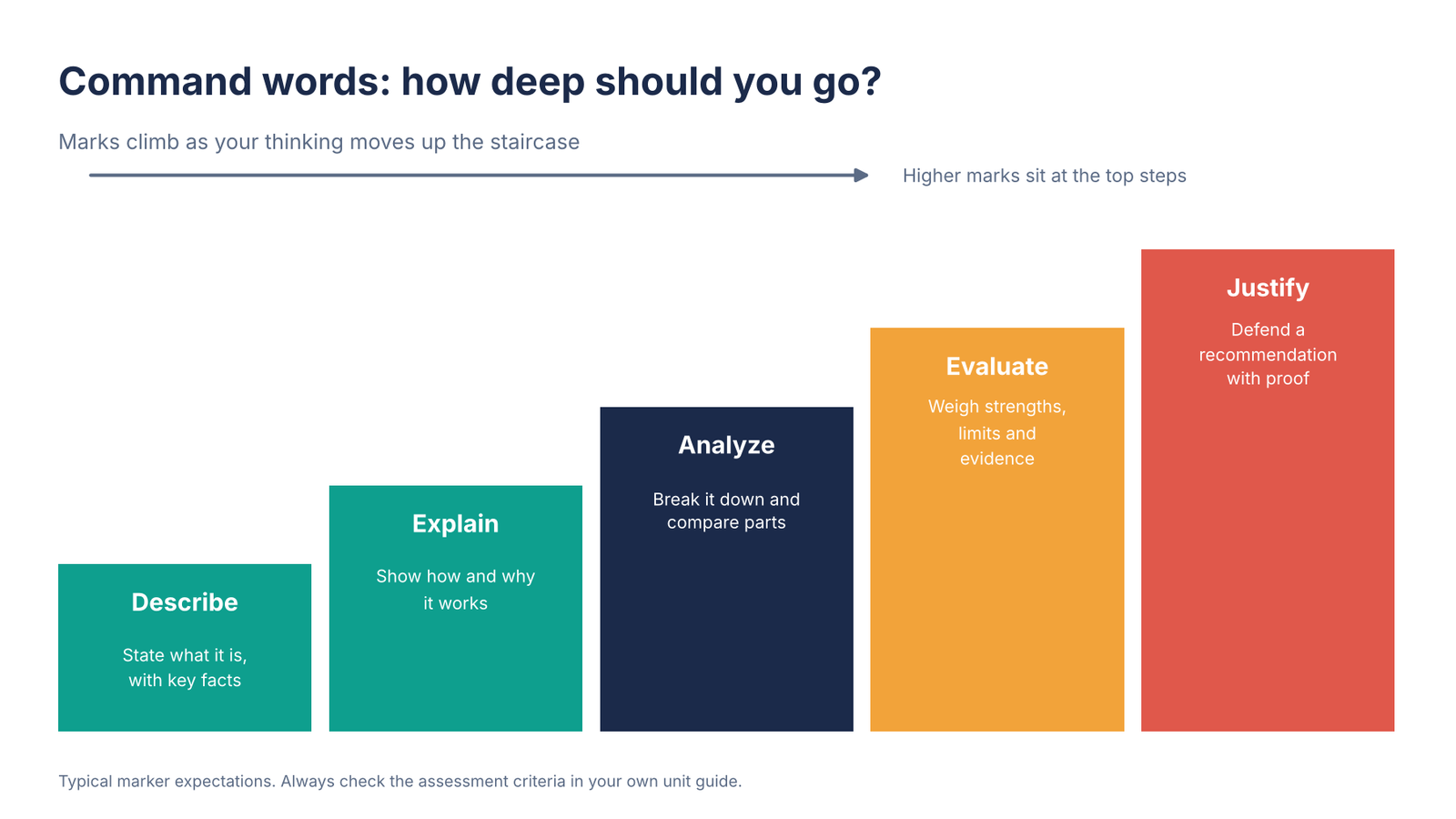
Here’s a quick test. If your answer to an “evaluate” question reads like a description, you’re sitting on the bottom step. Add strengths, limits and evidence, then reach a judgment.
Tip 2: Back Plan From Your Deadline
Most students plan forward: “I’ll start Monday and see how it goes.” Plan backward instead.
Put the submission date on a calendar. Then work backward and give each stage a fixed slot. The Assignment Deadline Countdown Timer makes this easy to see.
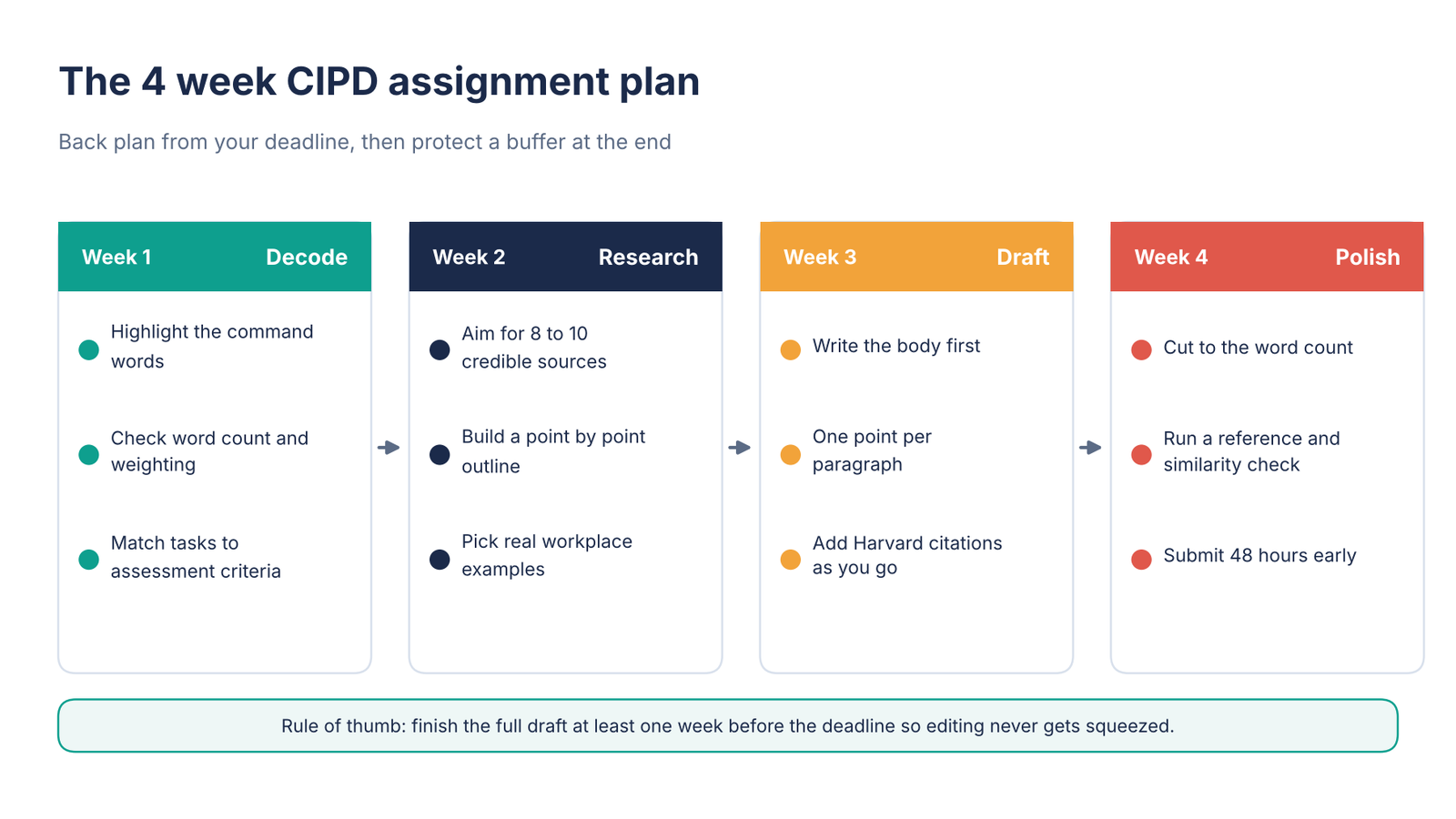
The rule that saves the most grades: finish the full draft at least one week before the deadline. Editing is where marks are made, and it can’t happen in the last six hours.
Tip 3: Break the Question Into Parts
A big question looks scary because it’s really several questions in a trench coat. Pull them apart.
Take this one: Explain how good communication helps managers build trust with their teams.
Split it into four mini questions:
- What is good communication?
- How does it help managers?
- How does it build trust?
- What’s a real example?
Now give each mini question its own paragraph or short section. Your answer will be complete, and the marker can see every part of it.
Now raise the level. If the command word were “evaluate”, you’d add: where does communication fail to build trust, and what evidence shows it? That’s the jump from describe to evaluate.
Tip 4: Use Evidence a Marker Will Respect
Opinions don’t earn marks. Evidence does. Build your reading list from sources a CIPD marker already trusts:
- Your course textbook and unit reading list
- CIPD research reports and its People Management magazine
- Peer reviewed journal articles
- Government and professional body reports
- Case studies your tutor shares
Skip random blogs, unsigned articles and anything with no date or author. Aim for eight to ten solid sources per major task, then use the best ones.
Working on a learning and development unit? Our guide to what an L&D strategy is shows how the data and frameworks fit together.
Tip 5: Connect Theory to Your Workplace
CIPD assessors love applied work. Show you can take a theory and use it on a real situation.
Use a simple paragraph pattern called PEEL:
- Point: state your claim in one sentence.
- Evidence: cite a source that supports it.
- Explain: say why the evidence matters.
- Link: tie it back to the question or to your workplace.
Here’s an example on teamwork:
Weekly goal setting meetings improve role clarity (Point). Research on goal setting links clear targets to better performance (Evidence, with a citation). That means people know what to prioritize each week (Explain). In my team, the Monday huddle did exactly this, which supports the theory and shows one limit: it only worked when every shift could attend (Link).
Notice the last sentence. A small limit or counterpoint is what turns description into critical evaluation.
Tip 6: Write Short, Clear Sentences
You don’t earn marks for complicated language. You lose them when the marker can’t follow your point.
Compare these two:
Long: “Managers who engage in effective communication practices are more likely to foster a trustworthy environment.”
Short: “Good communication helps managers build trust.”
The short version also saves words. When you’re close to the limit, cutting padding is the easiest edit you’ll ever make. Check your total with the free Word Counter, and ask your center how it treats a small overrun, because rules differ.
Tip 7: Reference in Harvard as You Go
Most CIPD centers expect Harvard referencing, but check your own unit guide to be sure. Do your references while you draft, not after.
An in-text citation looks like this:
(CIPD, 2023)
And a reference list entry looks like this:
CIPD (2023) Title of the Report. London: CIPD.
Every fact and every quote needs a citation, and every citation needs a matching entry in the list. Two free tools help here: the Citation Generator and the Citation Style Picker.
Reflective unit? Our CIPD Reflective Model Helper walks you through structuring a reflection.
Tip 8: Stay Inside the Misconduct Rules
This one matters more than ever. In the UK, 95% of full-time undergraduates now use AI in some way, and 94% use it on assessed work, according to the HEPI and Kortext Student Generative AI Survey 2026. Students are working in a gray zone, and CIPD has drawn a clear line.
CIPD’s Malpractice and Maladministration Policy (v3.1, March 2023) defines learner malpractice as an attempt to gain unfair academic advantage. It names plagiarism, including “passing off work of others or AI technology such as Chat GPT as their own”, copying another learner, collusion, and getting someone else or AI to produce part or all of your work.
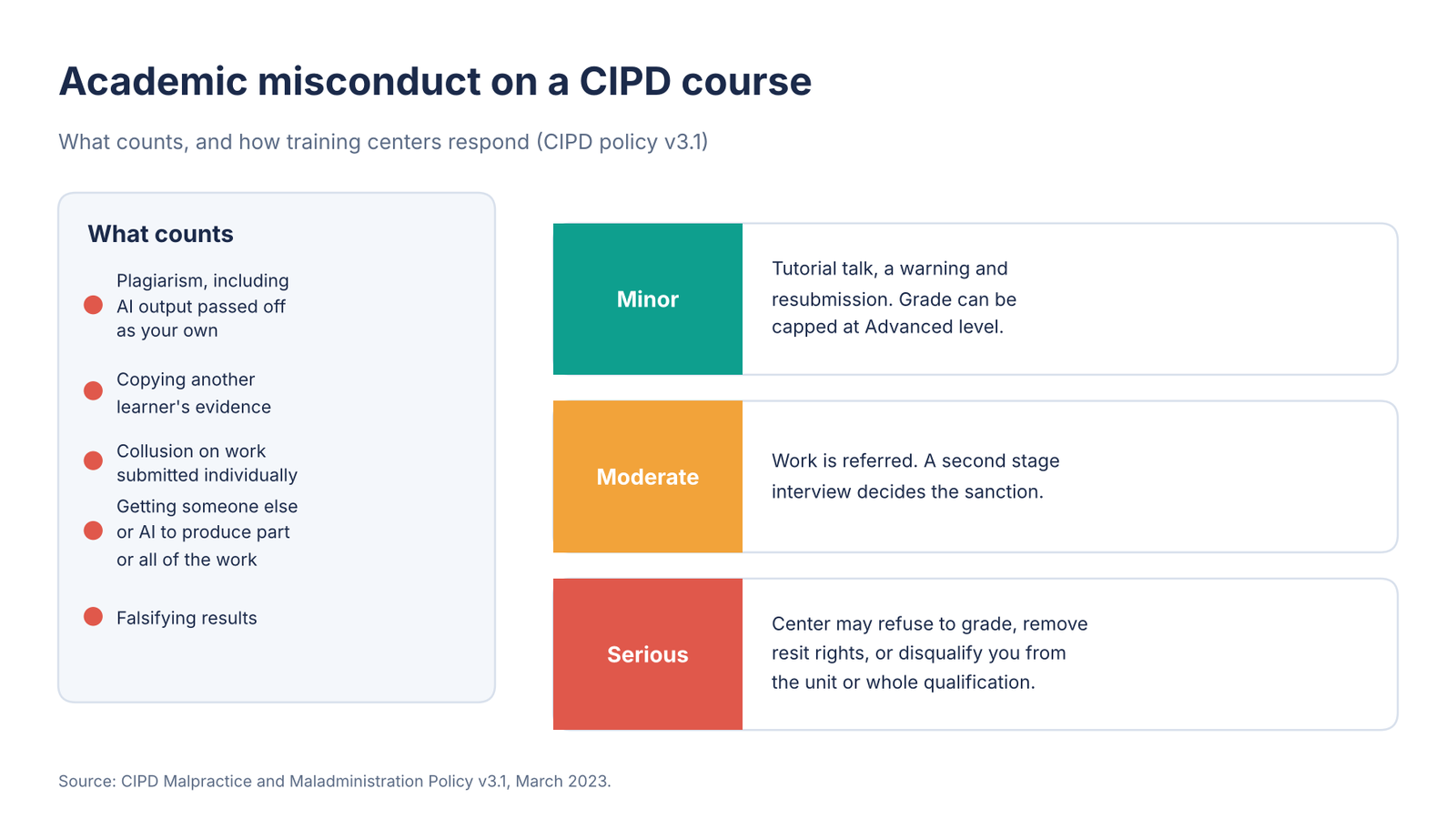
Responses scale with severity. A minor case can mean a tutorial discussion, a warning and resubmission. A serious case can mean the center refuses to grade the work, removes resit rights, or disqualifies the learner from the unit or the qualification.
The safe route is simple: the ideas, analysis and words are yours. Support that improves your own work, such as tutoring, feedback on a draft and explanations of difficult concepts, is a different thing from outsourcing the assignment. A tutor-led approach keeps you on the right side of that line, and it’s how our CIPD tutors work.
Tip 9: Run a Ten Minute Final Check
Before you submit, read the work out loud. You’ll catch awkward sentences your eyes skip. Then run this checklist:
| Check | Question to ask |
| Brief | Did I answer every part, in the order asked? |
| Command words | Did I go deep enough for each one? |
| Word count | Am I inside the limit for every task? |
| Evidence | Does each claim have a source? |
| Examples | Did I link theory to a real workplace situation? |
| Referencing | Does every citation match a list entry? |
| Originality | Is the wording mine, and does a similarity check look clean? |
| Polish | Spelling, grammar, headings and formatting? |
For the originality row, a quick similarity check with the free Plagiarism Checker gives you a preview before you submit.
Common CIPD Assignment Mistakes (and Fixes)
| Mistake | Fix |
| Describing when the task says evaluate | Add strengths, limits, evidence and a judgment |
| Starting too late | Back plan and finish the draft a week early |
| Generic examples | Use a real workplace situation, with details |
| Citations added at the end | Reference as you write |
| Ignoring the weighting | Spend words where the marks are |
| Padding to hit the word count | Cut filler, add analysis |
When to Get Expert Help
You don’t need a tutor for every assignment. But if you’re stuck on a unit, unsure what a command word wants, or running out of time, a quick session can save a week of guessing.
At PrestoExperts, our CIPD tutors coach you through the brief, your plan and your draft, so the work stays yours and your skills grow. Explore CIPD assignment help for Level 3, 5 and 7, or browse our full tutoring directory to find the right specialist.
Keep learning: If you’re also managing your study habits, read how to study more in less time, and see the online learning trends shaping how people learn right now.
Conclusion: Win the Assignment Before You Write It
A CIPD assignment is won in the planning. Decode the brief, back plan your time, answer every part, link theory to practice, reference as you go, and keep your work your own.
Ready for a stronger CIPD assignment? Book your free 20 minute trial session with a verified expert, or message us on WhatsApp and we’ll match you with a CIPD tutor today.