
Online learning trends used to be a list of buzzwords. Gamification! VR! Microlearning! Now there’s enough data to tell which ones changed how people actually study, and which ones are still hype.
This guide ranks seven shifts using numbers from HEPI, Coursera, the World Economic Forum and the U.S. National Center for Education Statistics. Each trend ends with one action you can take this semester.
If you want the shortcut, our best online class help services guide shows where to get expert support while you adapt.
The short version: AI is now a default study tool, skills matter more than degrees alone, short credentials are paying off, online and hybrid study is mainstream, short spaced sessions beat cramming, and human tutors still add something software can’t. Details and data below.
Trend 1: AI Becomes the Default Study Tool
This is the biggest shift, and the data is blunt. The HEPI and Kortext Student Generative AI Survey 2026 found that 95% of UK full-time undergraduates use AI in some way, up from 66% in 2024. And 94% use generative AI to help with assessed work.
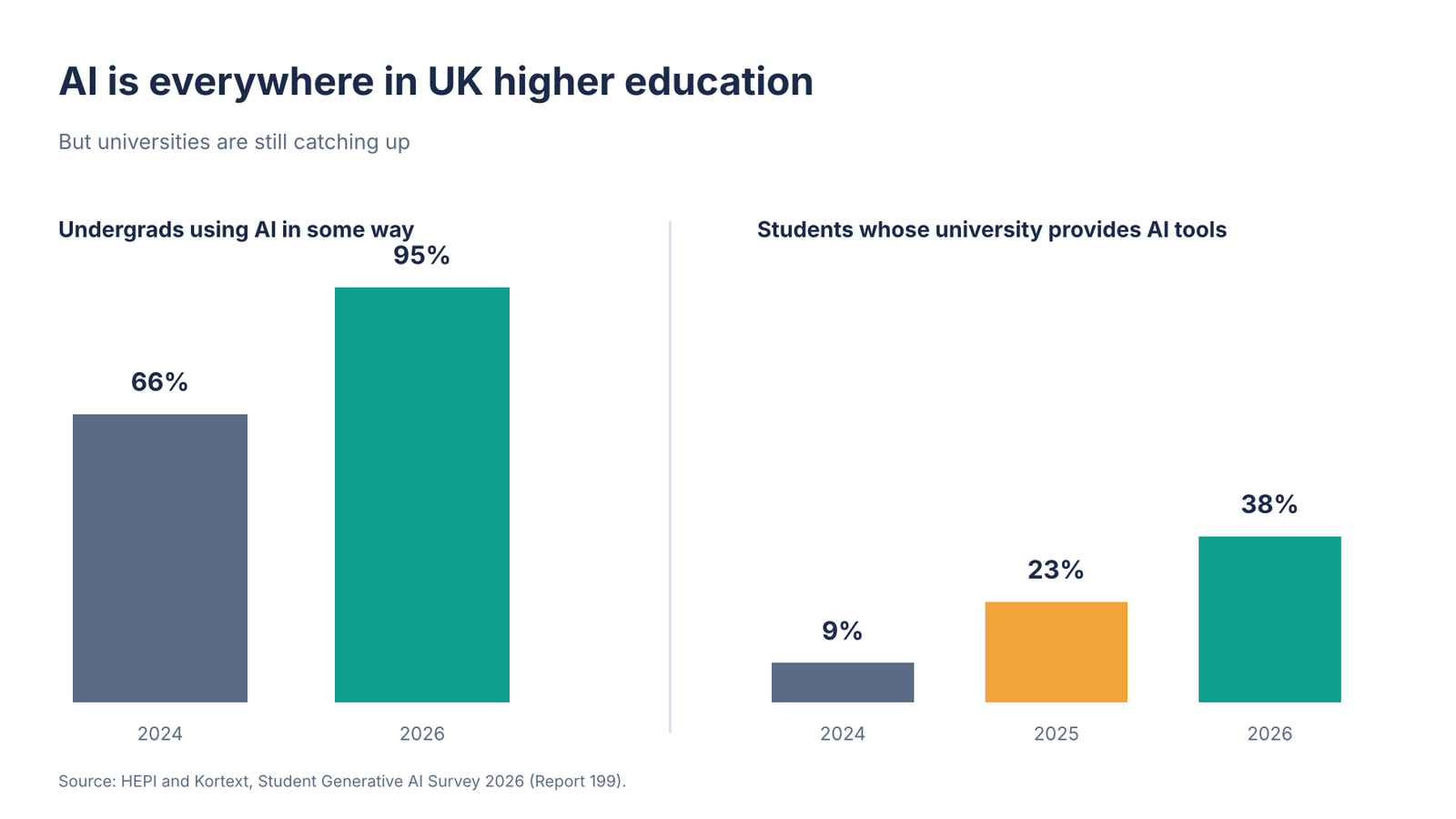
Universities are still catching up. Only 38% of students said their institution provides generative AI tools, up from 23% in 2025 and 9% in 2024.
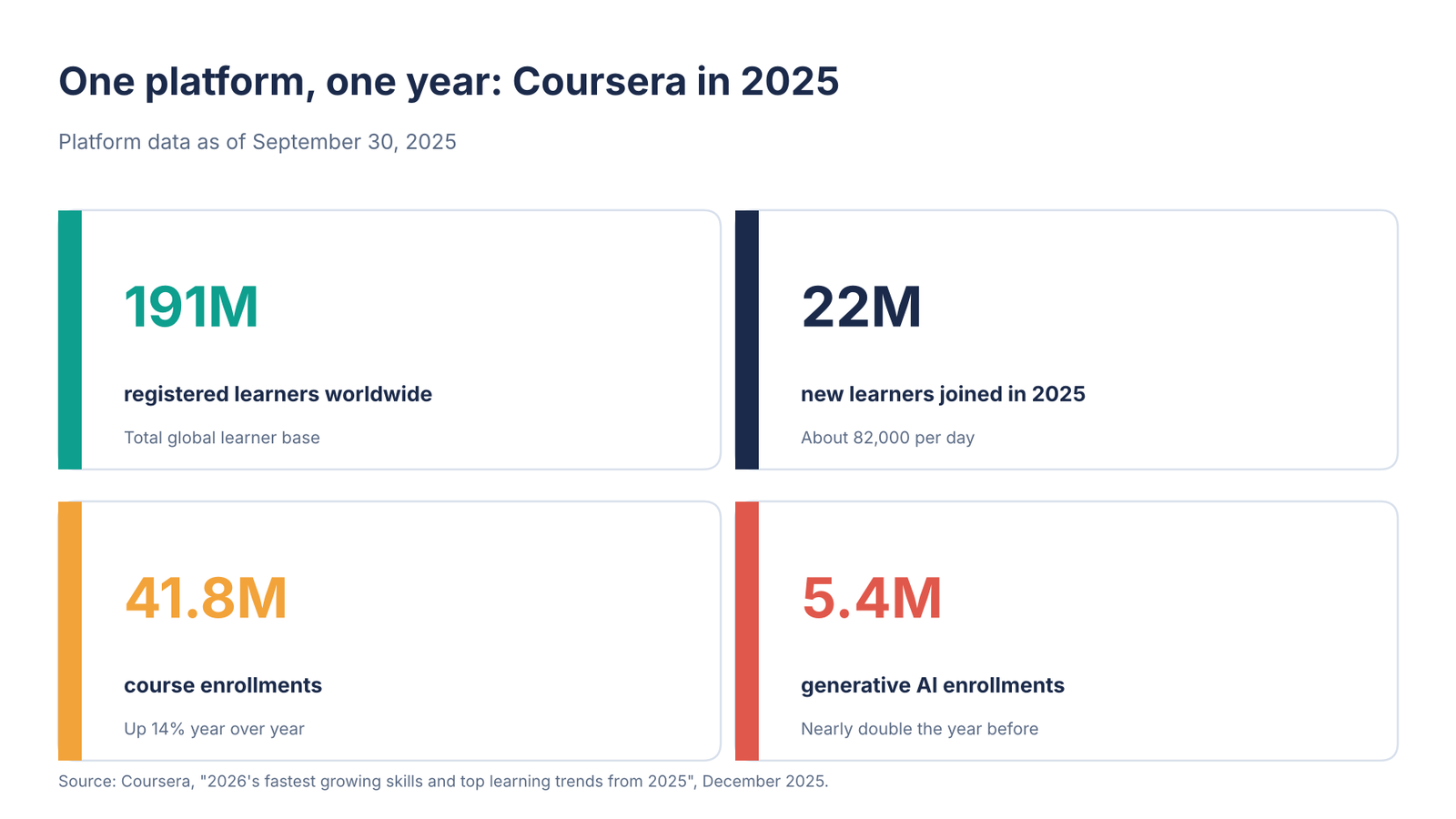
The same pattern shows up in course platforms. Coursera reported 5.4 million generative AI enrollments in 2025, nearly double the previous year, or about 14 every minute.
What to do: Use AI to explain, quiz and plan, not to write what you submit. Check your university’s policy first, because it differs by course.
Trend 2: Learning Gets Skills First
The World Economic Forum’s Future of Jobs Report 2025 puts a number on the pressure. Employers expect 39% of existing skill sets to be transformed or become outdated between 2025 and 2030. And if the global workforce were 100 people, 59 would need training by 2030.
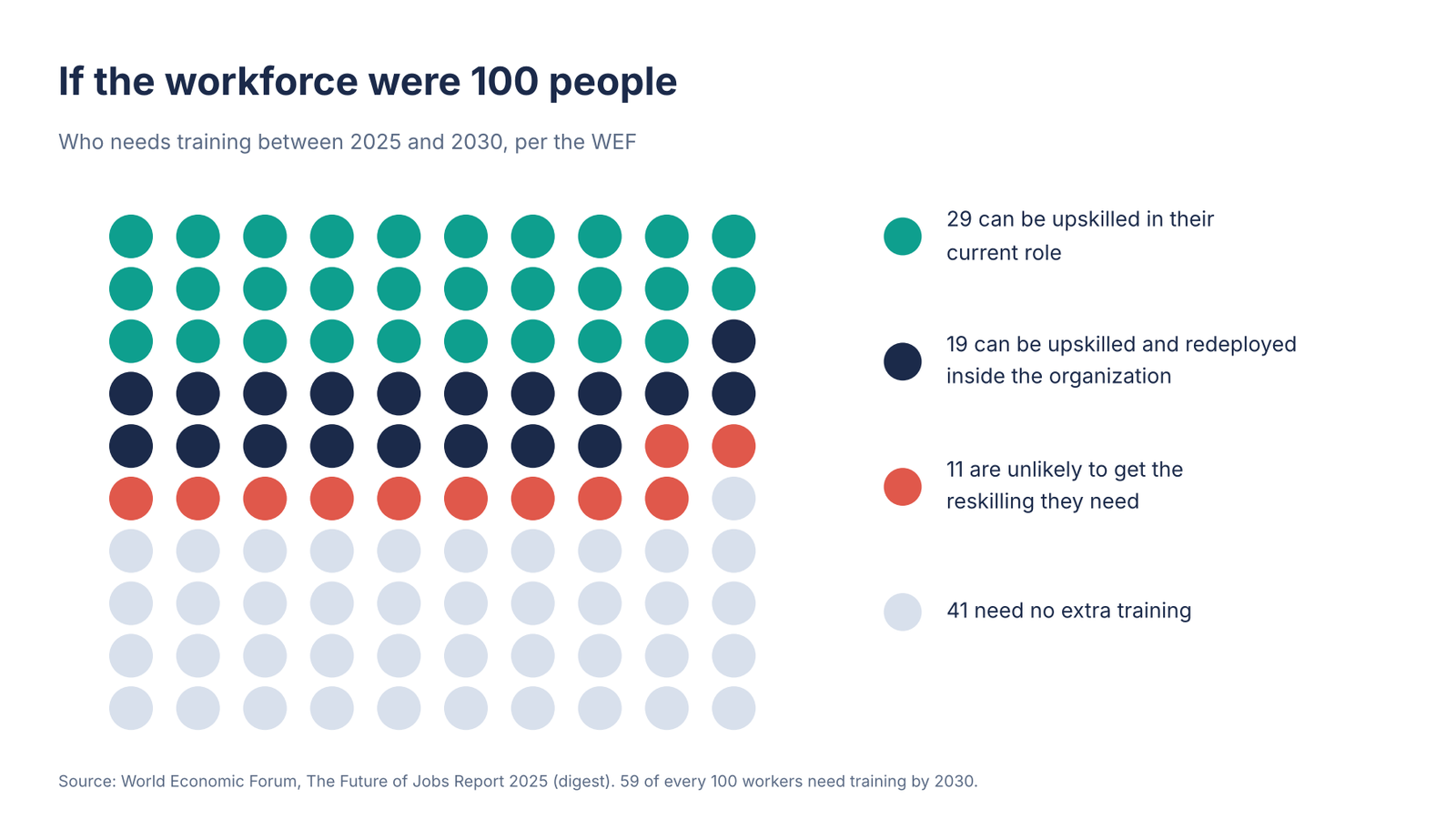
Look at the split. Twenty nine could be upskilled in their current role and nineteen could be upskilled and redeployed. Eleven are unlikely to get the reskilling they need. That last group is the one learners can avoid by acting early.
Meanwhile, 85% of surveyed employers plan to prioritize upskilling, and 63% call skill gaps a major barrier to transformation. AI and big data top the list of fastest-growing skills, and analytical thinking is the most sought-after core skill.
What to do: Pick one in-demand skill each term and add a project that proves it. HR students can start with our guide to what an L&D strategy is.
Trend 3: Short Credentials Pay Off
Full degrees aren’t going anywhere, but short credentials are gaining ground. Coursera’s 2025 learner and employer data shows why:
- 96% of employers say micro-credentials strengthen a candidate’s job application.
- 28% of entry-level employees with a micro-credential received a pay increase.
- 89% of credential earners built or strengthened soft skills, including critical thinking (72%) and problem solving (72%).
These are survey results from one platform’s learners and employers, so treat them as directional, not universal.
Coursera also reports that critical thinking rose from seventh place to the top skill by Q3 2025. In a world of AI answers, the skill of questioning them is the one people are chasing.
What to do: Choose credentials that map to a job description you’ve actually read. Stack two or three related ones instead of collecting random badges.
Trend 4: Online and Hybrid Study Are Mainstream
The pandemic pushed learning online. The question was whether it would snap back. U.S. data suggests it settled at a high level.
According to the National Center for Education Statistics, 61% of U.S. undergraduates took at least one distance education course in fall 2021, and 28% studied exclusively online. That was down from 75% and 44% in fall 2020, but it still means most undergraduates touched online learning.
Coursera’s scale shows the same appetite. Its learner base reached 191 million, with 22 million new learners joining in 2025 alone, about 82,000 per day.
What to do: If you study online or in hybrid mode, build a fixed weekly schedule. Flexibility without structure is where most students slip. Struggling with the math side? Our guide on what to do if you are struggling in math gives you a 7 day plan.
Trend 5: Short, Spaced Sessions Beat Cramming
Microlearning, usually lessons of 5 to 10 minutes, is popular on mobile apps. The reason it works has less to do with the format and more to do with timing.
A major review of ten study techniques by Dunlosky and colleagues (2013) rated two as high utility: practice testing and distributed practice. In plain words, test yourself, and spread your study over several days. Rereading and highlighting did not make the cut.
What to do: Replace one long session with three short ones across the week. End each with five minutes of closed book recall. Our study more in less time guide shows how.
Trend 6: Human Tutoring Still Wins Where It Counts
Software is cheap and always on. But a major meta-analysis of tutoring experiments found a pooled effect of 0.37 standard deviations on learning outcomes. Effects were stronger for teacher and paraprofessional tutors than for nonprofessional or parent tutors.
That evidence comes from preK-12 studies, so it doesn’t prove the same size effect in college. Still, it points the same way as what students tell us: a person who can spot your exact mistake is hard to replace.
The practical answer is a mix. Use AI for instant questions and a verified tutor for the hard parts. PrestoExperts matches you with tutors across business, finance, accounting, biology, SPSS statistics and computer programming, and your first 20 minute trial is free.
What to do: Book a short trial before you’re desperate. A 20 minute session can show you whether a topic needs a tutor or just another practice set.
Trend 7: Career Ready Skills Beat Course Counts
Learners are choosing courses for outcomes. Coursera’s fastest growing skills for 2026 include advanced prompting, AI agents and human-AI collaboration, alongside business, data science and personal development.
Employers want the same mix. The WEF names AI and big data, networks and cybersecurity, and technology literacy as the fastest growing skills, with resilience, flexibility and agility rising in importance.
What to do: Pair one technical skill with one human skill each term, such as data analysis plus presentation skills. That combination is hard for software to copy.
Your 2026 Trend Scorecard
| Trend | Strongest evidence | Your next move |
| AI as a study tool | 95% of UK undergrads use AI (HEPI, 2026) | Use it to learn, check your policy |
| Skills first | 39% of skills change by 2030 (WEF) | Add one in-demand skill per term |
| Short credentials | 96% of employers say they help (Coursera) | Stack related credentials |
| Online and hybrid | 61% took a distance course in fall 2021 (NCES) | Build a fixed weekly schedule |
| Spaced practice | Rated high utility (Dunlosky et al.) | Three short sessions, not one cram |
| Human tutoring | 0.37 SD pooled effect, preK-12 (NBER) | Book a trial for hard topics |
| Career ready skills | AI and big data fastest growing (WEF) | Pair technical and human skills |
Where Online Learning Is Heading Next
Expect three things. AI tools will move from optional to built in, as the HEPI provision numbers suggest. Employers will lean harder on proof of skills, from credentials to projects. And the best study setups will blend AI, short spaced sessions and a human expert.
If you’re taking an online class and need support, our best online class help services page explains how we work, and our tutoring directory lets you pick a specialist yourself. CIPD students can go straight to CIPD assignment help.
Conclusion: Learn Smarter, Not Just Online
The data tells one story. Learning is moving to AI, to skills, to short credentials and to flexible schedules. The students who win use those tools with structure, and bring in a human expert when the stakes are high.
Want a plan that fits your course? Book your free 20 minute trial session with a verified expert, or message us on WhatsApp and we’ll match you with the right tutor.