Every AI content detector promises the same thing: paste your text, get a score. The scores rarely agree, and the stakes for students are high.
So which AI content detector should you trust with an essay, a thesis or a journal article? We compared PrestoExperts with seven well-known tools on word limits, reports, privacy, claimed accuracy and fit. We also checked what independent research says, because vendor claims and independent tests often tell different stories.
Quick answer: For long academic documents, choose a detector that handles thousands of words, shows section-by-section scores and excludes your reference list. For short checks, free tools with 1,200 word caps work. Whatever you choose, treat the score as a signal, never as proof.
Full disclosure: PrestoExperts owns one of the tools in this list. We say so up front, we label every vendor claim as a claim, and we point out where other tools do something better.
In this guide
- How we compared the tools
- The 8 detectors at a glance
- Tool-by-tool reviews
- Vendor claims vs independent evidence
- What the Stanford study means for you
- How to read your AI score
- A safe workflow before you submit
- FAQ
How we compared the tools
We reviewed each tool’s public product page in October 2026. We recorded what each page states about word limits, reports, languages, privacy and accuracy. We did not run a lab test with our own sample set, so we do not publish our own accuracy percentages for other tools.
We scored each tool on five questions:
- Capacity: How much text can you check in one go?
- Detail: Do you get sentence or section-level feedback?
- Academic fit: Does it handle references, quotes and long documents?
- Evidence: Is accuracy backed by independent testing or only by the vendor?
- Access: Can a student use it directly, or only through an institution?
Where a number comes from the vendor, we label it a claim. Where we could not verify a detail, we say so.
The 8 detectors at a glance
| Tool | Free word limit | Section or sentence feedback | Downloadable report | Student access | Best for |
| PrestoExperts | Up to 10,000 words per check (150 word minimum) | Yes, chapter by chapter | Yes, PDF | Direct | Theses, dissertations, long papers |
| GPTZero | Free tier (check site for limits) | Yes | Check site | Direct | Educators and students |
| Turnitin | Not sold to individuals | Yes | Institution view | Through your university | Institutions |
| Originality.ai | Check site (paid focus) | Yes | Check site | Direct | Publishers and SEO teams |
| Copyleaks | Check site | Yes | Check site | Direct | Institutions and enterprises |
| QuillBot | 1,200 words per scan, 6 scans a day | Yes, with explainer cards | Premium only | Direct | Short checks plus writing tools |
| Scribbr | 1,200 words per submission | Yes, paragraph level | Not advertised | Direct, no sign-up | Quick free checks |
| ZeroGPT | 15,000 characters per check | Yes, highlighted sentences | Check site | Direct | Fast casual checks |
Sources: each tool’s public page and the vendor and independent studies listed at the end. Details checked October 13, 2026. Plans and limits change, so confirm on each site.
1. PrestoExperts AI Content Detector
The PrestoExperts AI content detector is built for long academic writing. It checks research papers, assignments, theses, dissertations, MBA projects, literature reviews and journal articles of up to 10,000 words in one check.
You get an AI percentage, a chapter-by-chapter breakdown, highlighted sentences and a downloadable PDF report. The report includes a cover page, an overview and the full text with AI-flagged sentences marked.
What stands out:
- Academic calibration: Methodology wording, passive voice and discipline terms are not treated as AI signals on their own.
- Fair to non-native writers: The tool states that non-native English is never counted as evidence of AI.
- Clean scoring: References, direct quotes, headings and table-of-contents lines are excluded by default, and the report lists exactly what was excluded.
- Paraphrase awareness: It separates AI-generated text from AI text that was later paraphrased.
- Privacy: Files are read in your browser. PrestoExperts states that nothing is saved, logged or shared.
Where it falls short: PrestoExperts has not published an independent benchmark of its accuracy. The page itself says no detector is 100% accurate and that its scores will not match Turnitin or GPTZero number for number. Treat it as a strong first check, then bring in a human reviewer for anything that matters.
Best for: Students and researchers with long documents who want section-level detail and a report they can keep.
2. GPTZero
GPTZero is one of the best-known names in AI detection. Its pricing page states it is trusted by over 10 million teachers and students, used in over 100 countries, and named an official AI detector partner of the American Federation of Teachers.
It offers sentence-level highlighting, plus related products such as a plagiarism check and an authorship feature that records the writing process. That last feature matters, because process evidence is one of the strongest defenses against a false flag.
The accuracy claim: In a benchmark GPTZero published itself, it reported 99.3% accuracy and a 0.24% false positive rate across 3,000 samples. That is a vendor result, and the test also compared GPTZero with rivals it competes against. Independent testing cited in third-party roundups put its F1 score at 0.94, the highest among the three tools in that comparison.
Where it falls short: We could not confirm current plan prices from the pricing page, so check the site before you buy.
Best for: Educators, and students who want an authorship record alongside a score.
3. Turnitin
Turnitin is the detector most universities use, which makes it the one students worry about most. It analyzes a paper in segments, scores each sentence and averages the scores into an overall prediction.
Turnitin states that its AI writing detector has a false positive rate of less than 1% for documents containing more than 20% AI-generated content. It also says its tool does not make a determination of misconduct. It gives educators data to use alongside institutional policy.
Where it falls short: You cannot buy it as an individual. Access runs through your university. Reporting summarized on Wikipedia also notes that Turnitin has stated a 15% false negative rate, which means some AI text goes undetected.
Best for: Institutions. As a student, you can only learn how it behaves by asking your instructor what the policy is.
4. Originality.ai
Originality.ai targets publishers, agencies and SEO teams, and offers AI detection alongside plagiarism checking. We could not confirm its current pricing from a primary page, so check the site.
In a third-party roundup, Originality.ai scored 96.7% on paraphrased and adversarial text on the independent RAID benchmark. The same roundup placed its false positive rate between 5% and 7% in independent estimates. GPTZero’s own benchmark reported 4.79% for Originality.ai, which falls close to that range.
Where it falls short: A false positive rate in that range means roughly 1 in 20 human documents could be flagged, which matters for student work.
Best for: Content teams that publish at volume and want strict screening.
5. Copyleaks
Copyleaks offers AI detection and plagiarism checking, and is widely discussed alongside GPTZero and Originality.ai in 2026 comparisons.
In GPTZero’s published benchmark, Copyleaks reached 90.7% accuracy with a 5.26% false positive rate. Independent Leap AI testing, as summarized in a third-party roundup, placed its F1 score at 0.87, below GPTZero (0.94) and Turnitin (0.92).
Where it falls short: Numbers from a competitor’s benchmark deserve caution, and we could not confirm Copyleaks’ current plans or limits from a primary page.
Best for: Teams that want a second opinion alongside other detectors.
6. QuillBot AI Detector
QuillBot’s detector is free for up to 1,200 words per scan and 6 scans per day. Premium removes the word limit and unlocks full explainer cards and downloadable reports.
QuillBot says its detector separates fully AI text from text that a person wrote and then refined with AI. It also offers sentence-level insight and supports 20+ languages. It cites a 99% detection rate from the independent RAID benchmark. That is the vendor’s description of a third-party test, so check the RAID leaderboard yourself.
QuillBot also states that scores are signals, not verdicts, and that you should disclose AI use rather than revise to change a score. We agree.
Where it falls short: The 1,200 word cap means a thesis chapter needs several scans.
Best for: Short checks, especially if you already use QuillBot’s grammar tools.
7. Scribbr AI Detector
Scribbr offers unlimited free checks of up to 1,200 words each, with no sign-up. It classifies text as AI-generated, AI-refined or human-written, and gives paragraph-level feedback in English, Spanish, German and French.
Scribbr tested detectors itself and reported that the highest accuracy it found was 84% for a premium tool and 68% for the best free tool. That is a useful reality check for anyone treating a free score as final.
Where it falls short: Scribbr’s detector gives only a percentage and does not suggest improvements, and the 1,200 word cap suits short pieces only.
Best for: A quick, no-account sanity check on a short passage.
8. ZeroGPT
ZeroGPT accepts up to 15,000 characters per check, which is roughly 2,500 words. It highlights sentences and shows a gauge with the AI percentage.
The site also sells an AI humanizer that rewrites text “to pass review.” We do not recommend using any tool to hide AI use from your institution. If AI helped with your work, follow your policy and disclose it.
Where it falls short: The product page gives no independent accuracy data, so cross-check its score with another tool.
Best for: Fast, casual checks, with the score taken lightly.
Vendor claims vs independent evidence
Accuracy numbers are the hardest part of any AI detector comparison. Almost every vendor reports a strong result on its own test set. Independent researchers usually find lower numbers and more disagreement.
| Source | What it reports | Who ran the test |
| GPTZero benchmark | GPTZero 99.3% accuracy, 0.24% false positives; Copyleaks 90.7% and 5.26%; Originality.ai 83.0% and 4.79% | Vendor (GPTZero) |
| Turnitin | Under 1% false positives for documents above 20% AI content | Vendor |
| QuillBot | 99% detection rate cited from the RAID benchmark | Vendor, citing a third-party test |
| Leap AI testing (via a third-party roundup) | F1 of 0.94 for GPTZero, 0.92 for Turnitin, 0.87 for Copyleaks | Independent, reported secondhand |
| Scribbr’s own research | Best premium tool 84% accurate, best free tool 68% | Publisher test of multiple tools |
| Weber-Wulff and colleagues, 2023 (via Wikipedia) | Tools tested scored below 80% accuracy, with only 5 over 70%; accuracy fell after paraphrasing | Independent academic study |
The pattern is clear. Vendor results cluster above 90%. Independent tests land lower, and every tool struggles with paraphrased text.
Why AI detector false positives matter
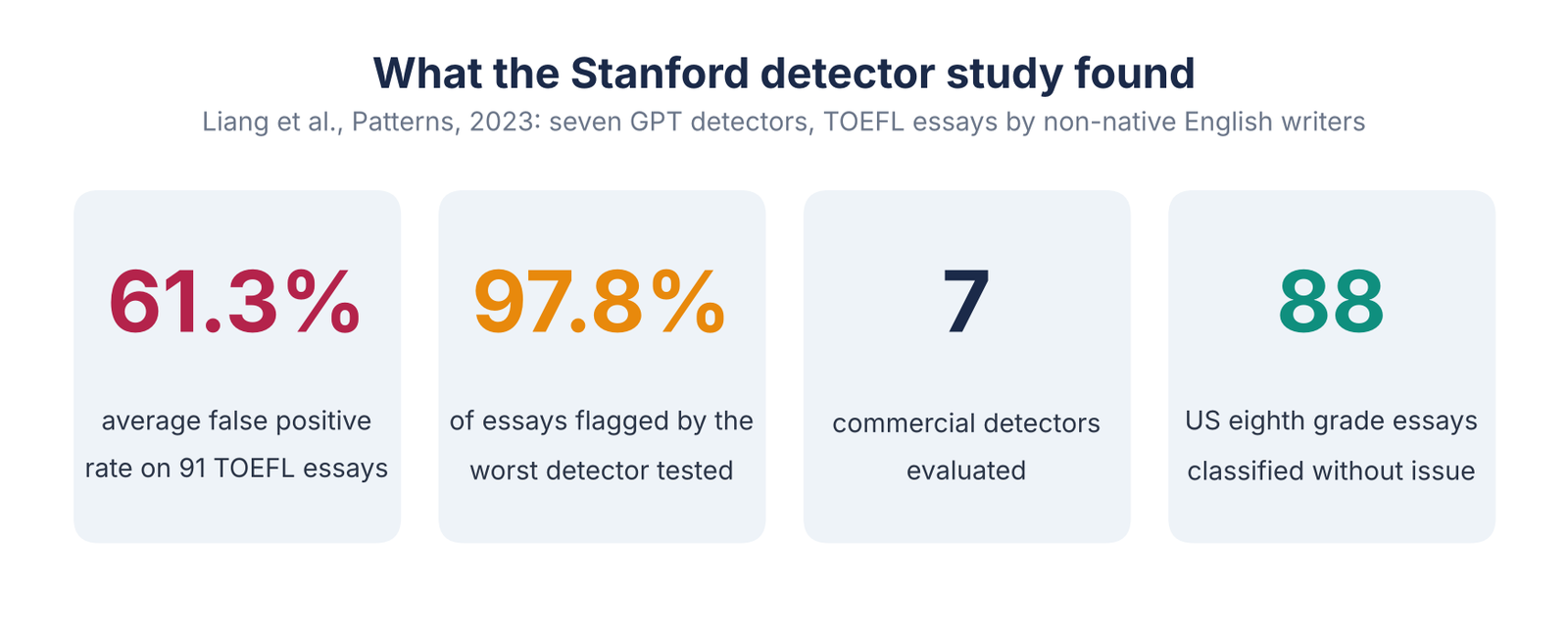
The most important independent study is from Stanford. Liang and colleagues ran 91 TOEFL essays by non-native English writers through seven popular GPT detectors. The detectors flagged them as AI at an average false positive rate of 61.3%. One detector flagged 97.8% of the essays.
The same detectors classified 88 essays by US eighth graders without trouble. The researchers linked the gap to perplexity, a measure of how predictable the word choices are. Writers with a limited vocabulary tend to write more predictably, and detectors read that as machine-like.
This does not mean every modern detector behaves the same way. The study dates from 2023, and vendors have updated their models since. But it explains a lasting rule: formal, formulaic or non-native writing is more likely to be flagged by mistake.
That is why PrestoExperts and QuillBot both warn that academic definitions, legal copy and structured writing can score higher than expected.
How to read an AI detection score
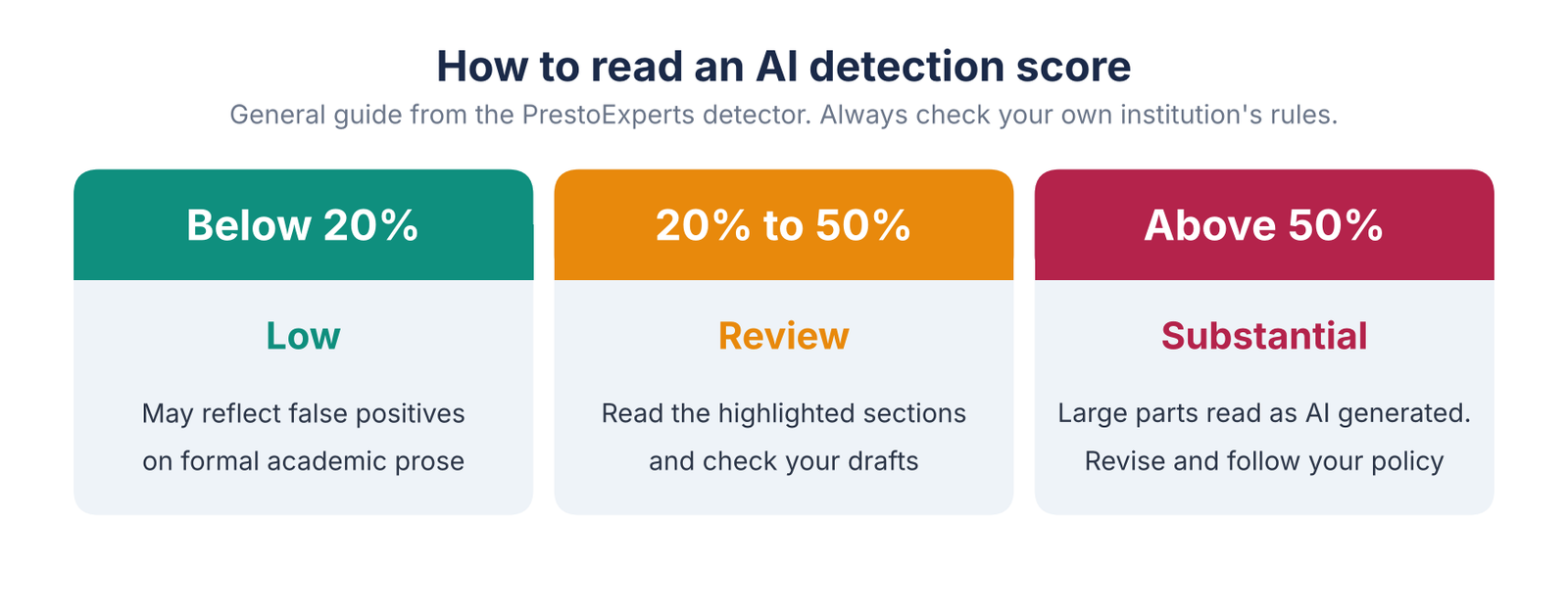
There is no universal threshold. Your university, supervisor or journal sets the rules. As a general guide from the PrestoExperts detector:
- Below 20%: It may reflect false positives on formal prose.
- 20% to 50%: Review the highlighted sections and compare them with your drafts.
- Above 50%: Large parts read as AI-generated. Revise honestly and follow your AI policy.
Look at the section breakdown before you worry. If only the literature review or methodology is flagged, that pattern is common in academic writing.
A safe workflow before you submit
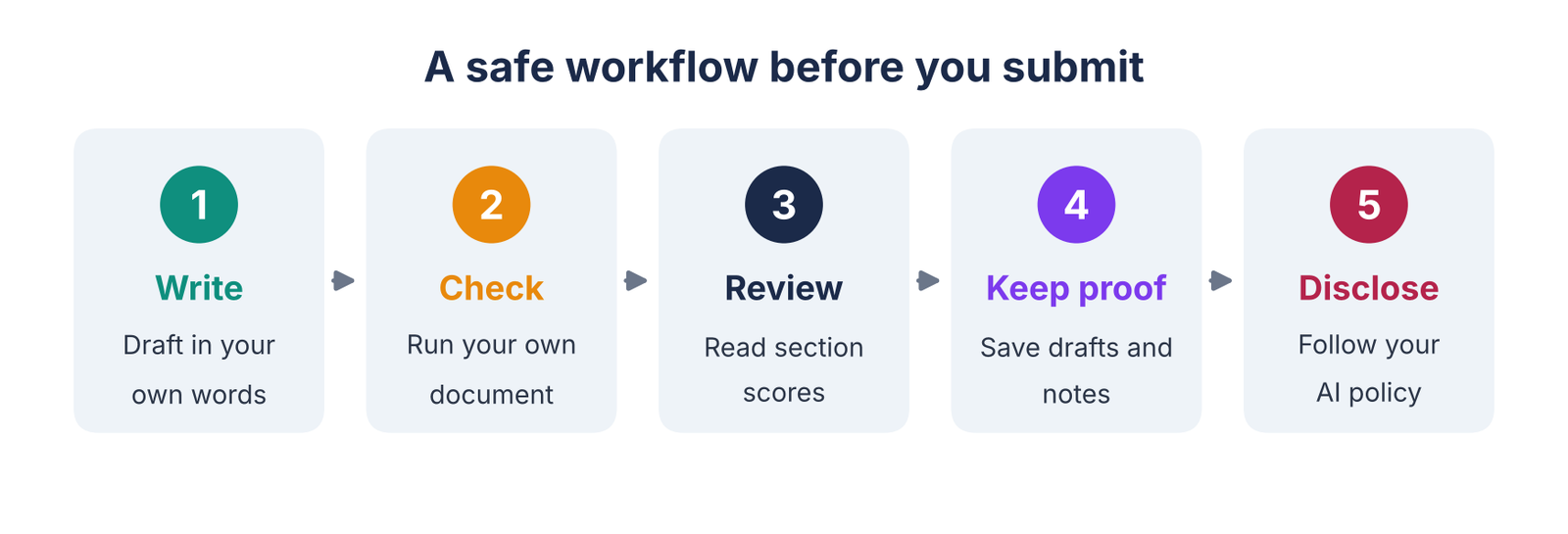
- Write in your own words. Draft from your notes and sources.
- Check your own document. Run it through one or two detectors, not ten.
- Review section scores. Read the flagged passages and ask whether they sound like you.
- Keep proof. Save drafts, notes, data files and version history. They are your best evidence if a detector gets it wrong.
- If AI helped with editing or language support, say so under your institution’s policy.
Do not use paraphrasers or humanizers to hide AI-written text. That approach can break academic integrity rules, and some detectors, including PrestoExperts, specifically look for paraphrased AI text.
Which AI content detector should you choose?
- You have a thesis or dissertation: Use a tool built for long documents with section scores and a report, such as the PrestoExperts detector.
- You have a short passage: Scribbr or QuillBot’s free tier works within its 1,200 word cap.
- You want an authorship record: GPTZero offers writing-process tracking.
- You publish content at scale:ai or Copyleaks fit that workflow.
- You worry about Turnitin: Ask your instructor how scores are used, and keep your drafts.
For anything high-stakes, combine a detector with a plagiarism check. The two tools answer different questions. One looks for AI-style writing, the other for copied text.
FAQ
What is the best AI content detector?
No single tool wins in every test. For long academic documents, a detector with section-level scores, reference exclusion and a downloadable report fits best, and the PrestoExperts AI content detector offers those features. For independent accuracy, review current third-party benchmarks such as RAID.
Are AI content detectors accurate?
They are useful signals, not proof. Vendors report 90%+ accuracy on their own tests, but independent studies find lower numbers, especially on paraphrased text and non-native English writing.
Is there a free AI content detector for a thesis?
Yes. The PrestoExperts AI content detector is free for documents up to 10,000 words. Scribbr and QuillBot offer free checks capped at 1,200 words each.
Why did my own writing get flagged as AI?
Formal and formulaic writing shares features with AI text. Non-native English writers face a higher risk, as the Stanford study showed. Keep your drafts and notes, and ask your institution how it handles disputed flags.
Can Turnitin detect ChatGPT?
Turnitin has an AI writing detector that scores segments of a paper and averages the results. It states a false positive rate under 1% for documents with more than 20% AI content, but it also reports a false negative rate, so it can miss AI text.
Do AI detectors work on paraphrased text?
Less reliably. Independent research shows accuracy drops after paraphrasing. Some tools, including PrestoExperts, Scribbr and QuillBot, try to flag AI-refined or paraphrased text separately.
Will the PrestoExperts score match Turnitin?
No, not number for number. Each tool uses different models and thresholds. A high score on one tool is a good reason to review those passages before submission.
Is my document stored when I use an AI detector?
It depends on the tool. PrestoExperts states that files are read in your browser and nothing is saved, logged or shared. Scribbr says it does not store or share submissions. Check each privacy policy before you upload sensitive work.
What is the difference between an AI detector and a plagiarism checker?
An AI detector estimates whether text was written by an AI model. A plagiarism checker finds text copied from existing sources. A document can be original but AI-written, or copied without any AI.
Conclusion: use detectors as a check, not a verdict
An AI content detector is a smoke alarm, not a judge. It tells you where to look, and your drafts, notes and honest disclosure carry the weight if anyone asks questions.
Ready to check your draft? Open the free PrestoExperts AI content detector and get a section-by-section report in minutes.
Flagged sections in your thesis or dissertation? Our verified PhD and Master’s qualified tutors review flagged passages with you, strengthen your own argument and evidence, and help you document your writing process. They work one-on-one, 24/7, and your first 20-minute session is free. Message us on WhatsApp to get started.
Next steps in your writing workflow:
- Run a free plagiarism check on the same draft
- Pick a stronger title with the research paper title generator
- Sharpen your argument with the thesis statement generator
- Get publication support from our research publication experts
PrestoExperts papers and tutoring are intended for research, learning and reference purposes. Always follow your institution’s academic integrity policy. Detector scores are estimates and should never be the sole basis for an academic decision.