SEO DETAILS (not part of the published post)
| Site | PrestoExperts.co.uk |
| Primary keyword | research paper title |
| Secondary keywords | research paper title generator, research project title generator, how to write a research paper title, research title examples, thesis title, dissertation title, good research title, research title length, descriptive declarative interrogative title, running title, working title |
| Slug | /how-to-write-a-research-paper-title/ |
| Meta title (55 chars) | How to Write a Research Paper Title: 10 Tips + Examples |
| Meta description (143 chars) | Learn how to write a research paper title with a simple formula, 10 tips, length rules and real thesis examples. Free title generator included. |
| Post type | How-to guide with list structure (Ahrefs types: how-to post plus list post), with tool CTA |
| Last updated | October 23, 2026 |
| Content sheet row | 4 (BP). Original working title “Tips to Create the Best Research Paper Title in 2027” refined for search intent |
| Search volume | US 390, Global 2.3k (from your content sheet) |
| Author and reviewer | [ADD before publishing: author name, credentials, and the PrestoExperts research tutor who reviewed this guide] |
How to Write a Research Paper Title: 10 Tips, Formulas and Examples
A strong research paper title does three jobs at once. It tells readers what your paper covers, it helps databases and Google Scholar find it, and it sets the tone for your argument. Yet many students write it in the last five minutes.
This guide shows you how to write a research paper title that works for an assignment, a dissertation or a journal submission. You will get a simple formula, ten tips, a length guide built from four public sources, a step-by-step makeover and real titles from completed theses. If you want a head start, our free research project title generator gives you eight options in seconds.
Quick answer: Name your key variables, add your population and method, cut filler words, and aim for about 10 to 15 words. Use one colon at most. Test the result against the 5-point checklist below.
In this guide
- What makes a good research paper title?
- Research paper title length
- 10 tips to write a research paper title
- Research paper title examples: makeover, before and after, and real titles
- Common mistakes
- When to use a title generator
- FAQ
What makes a good research paper title?
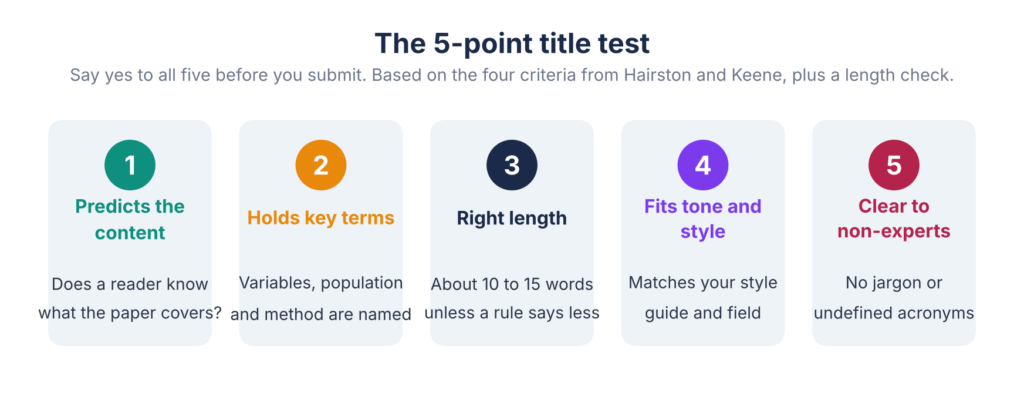
A good research paper title predicts the content, uses the right keywords, reads clearly and fits the tone of your paper. Rhetoric scholars Hairston and Keene set out four goals for a title: it should predict the content, interest the reader, reflect the tone of the writing and contain important keywords.
Enago Academy shows why this matters with a nursing example. Four titles can describe the same study about meditation and nurses, yet only one meets all four goals. That title pairs a catchy main phrase with a subtitle that names the method and topic.
Your title is also the first thing a supervisor or editor reads. Grammarly’s guide notes that it may be the only part of your thesis some readers ever see. Treat it as your paper’s headline, not an afterthought.
Title, topic, research question and thesis statement
Students often mix these up, so here is the difference.
| Term | What it is | Example |
|---|---|---|
| Research topic | The broad area you study | Student sleep and exam results |
| Research question | The question your study answers | Is sleep quality related to exam performance among first-year business students? |
| Thesis statement | The main claim of an argumentative paper | Universities should protect sleep time during exam weeks. |
| Research paper title | The short, specific name of your finished paper | Sleep Quality and Exam Performance: A Survey Study of First-Year Business Students |
| Running title | A shortened version for page headers | Sleep and Exam Performance |
A strong title usually grows out of a clear research question, so settle the question first.
Research paper title length: what the guides say
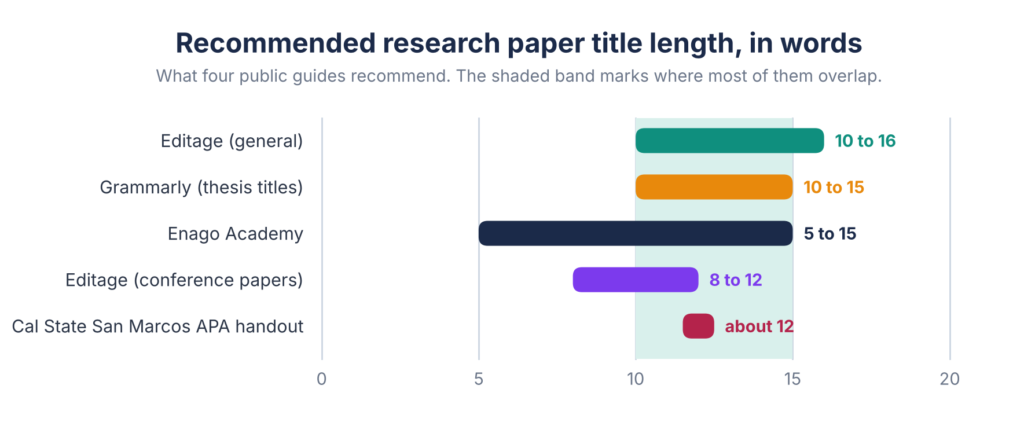
Most guides land on the same range. The table below shows what four public sources recommend.
| Source | Recommended length | Notes |
|---|---|---|
| Editage (research paper titles) | 10 to 16 words | Also advises 3 to 5 searchable keywords |
| Grammarly (thesis titles) | About 10 to 15 words | Clear, accurate and brief |
| Enago Academy | 5 to 15 words | Describe topic, method, sample and results |
| Cal State San Marcos APA 7 handout | About 12 words | Sample title on the cover page, “in about 12 words” |
| Editage, conference papers | 8 to 12 words | Shorter range for conference formats |
Sources: the linked guides, checked October 23, 2026.
Research adds one caution. A 2015 study in Royal Society Open Science found that journals publishing shorter titles tended to earn more citations per paper, but the authors describe this as a correlation, not proof. Elsevier’s summary of earlier work shows the link between length and citations is mixed. So chase clarity first, then trim.
Always check your own rules. Some journals cap titles at 12 words and others allow 25, and your university handbook may set a limit for dissertation titles.
10 tips to write a research paper title
1. Write a working title first, then finalize it last
Start with a rough working title so your writing stays focused. Then revise it after you finish your abstract and results, because your scope often shifts while you write.
Editage recommends drafting the final title after the abstract. The abstract already holds your variables, population and outcome, so the title almost writes itself.
2. Name your key variables, population and method
Strong titles carry specific nouns, not vague labels. Ask four questions: What am I studying? Who or what is the sample? How did I study it? Where or when does it apply?
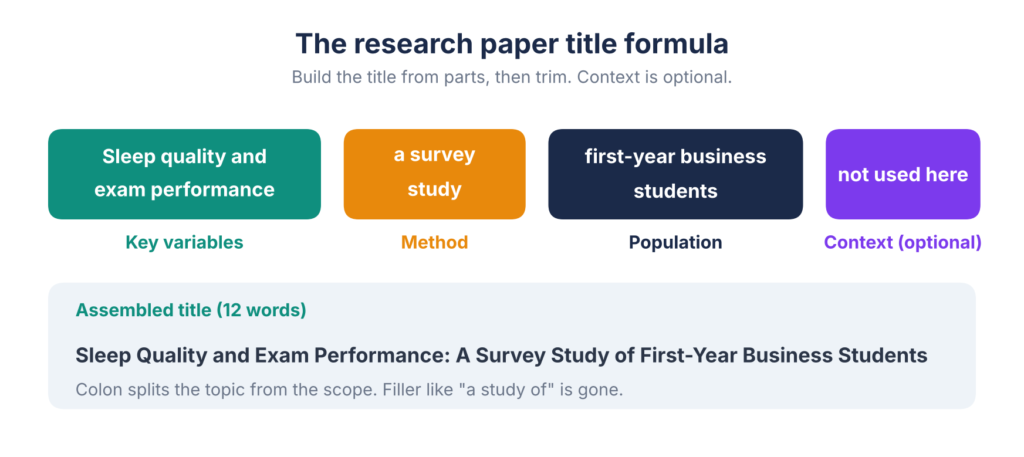
Use this building formula:
[Key variables]: A [method] study of [population] ([context, if it matters])
For example: “Sleep Quality and Exam Performance: A Survey Study of First-Year Business Students”. That title names two variables, a method and a population in 12 words.
You do not need every element every time. Use this guide to decide.
| Include this | When |
|---|---|
| Key variables | Always |
| Population or sample | When your findings apply to a defined group |
| Method or design | When it changes how readers judge the evidence, or your journal requires it |
| Location | When the place shapes the results, such as policy or environment studies |
| Time period | When timing matters, such as a pandemic or a policy change |
| The main finding | Only when your analysis fully supports it |
3. Put your most searchable keywords first
Readers and databases scan titles left to right. Lead with the terms people actually search, such as “employee retention” or “nurse burnout”, rather than starting with “An investigation into”.
Pick three to five keywords from your topic, then check them against the keyword list your journal or university requires. Use plain, standard terms over clever coinages, since Google Scholar and library databases match exact wording. Before you commit, search your main phrase in Google Scholar and see whether it brings up studies like yours. If it does not, the field may use a different term.
4. Choose the right title type
Research titles come in three common types. Each suits different work.
| Type | What it does | Example | Trade-off |
|---|---|---|---|
| Descriptive | States topic and scope, not the result | Employee Wellbeing and Retention in Small Retail Businesses | Safe and clear, less punchy |
| Declarative | States the main finding | Flexible Scheduling Reduces Nurse Turnover in Hospital Wards | Strong, but only if your data supports it |
| Interrogative | Asks a question | Does Remote Work Improve Employee Retention in Technology Firms? | Engaging, best for tests of a clear hypothesis |
Jamali and Nikzad studied 2,172 articles in six PLOS journals in 2011. They found question titles were downloaded more but cited less. Titles with colons tended to be longer and got fewer downloads and citations. The findings are descriptive and field-specific, so use them as a nudge, not a rule.
5. Match your verbs to your evidence
Your title makes a promise, so keep it honest. A survey can show that two things are linked. It usually cannot prove that one causes the other.
| Overclaims | Safer wording |
|---|---|
| Social Media Causes Anxiety in Students | Social Media Use and Anxiety Symptoms Among Undergraduates |
| Flexible Hours Improve Employee Retention | Flexible Hours and Employee Retention: A Survey of Retail Staff |
| Mindfulness Reduces Nurse Burnout | Mindfulness Training and Nurse Burnout: A Pilot Study |
Use words such as “association”, “relationship” or “predictors” for survey and correlational work. Save “effect”, “impact” and “reduces” for designs that can support them, such as experiments. ResearchMethod.net makes the same point in its title guide.
6. Use one colon, and only when it adds information
A colon splits a short hook from an explanatory subtitle. It works well when the second half adds your method or scope.
Keep it to one colon. If the subtitle only repeats the main title, delete it.
7. Cut filler words
Phrases such as “A study of”, “An investigation into” and “Research on” add length and no meaning. Every title already describes research, so drop them.
Compare “A Study on the Impact of Social Media on Students” with “Social Media Use and Academic Performance Among Undergraduates”. The second names the variables and the population in fewer words.
8. Avoid jargon and unexplained acronyms
Choose terms that a smart reader outside your field would understand. Grammarly advises being specific without relying on complex jargon, which helps your work reach a wider audience.
Spell out abbreviations unless they are better known than the full term. A title with an undefined acronym can send readers away before they reach your abstract.
9. Match your style guide and your level
Follow the capitalization and punctuation rules in your style guide, whether APA, MLA or Chicago. All three usually use title case for paper titles. Do not end a title with a period, and use a question mark only for question titles.
The right shape also depends on what you are submitting.
| Document | Typical title approach | Check first |
|---|---|---|
| Assignment or essay | Clear and specific, often 8 to 12 words | Your module brief |
| Dissertation or thesis | Variables, population and method, about 10 to 15 words | University handbook and supervisor |
| Journal article | Keyword-rich, within the journal’s cap | Author guidelines |
| Conference paper | Shorter and sharper, about 8 to 12 words | Call for papers |
10. Test your title before you submit
Run your draft through the 5-point test. If any answer is no, revise.
Then ask a classmate or tutor to read only the title and tell you what the paper is about. If they guess wrong, your title is hiding something.
Research paper title examples: before and after
A step-by-step makeover: 22 words down to 12
Here is one title taken from rough draft to final. We start from a one-sentence answer: “I surveyed first-year business students at one university to see whether poor sleep is linked to lower exam scores.”
| Draft | Title | Words | What we did |
|---|---|---|---|
| 1. Rough | A Research Study Investigating the Relationship That Exists Between How Well First-Year Business Students at One University Sleep and Their Exam Scores | 22 | Wrote the idea as a sentence |
| 2. Trimmed | An Investigation Into Sleep Quality and Exam Performance Among First-Year Business Students | 12 | Swapped everyday wording for standard terms |
| 3. Core | Sleep Quality and Exam Performance Among First-Year Business Students | 9 | Cut the filler opening |
| 4. Final | Sleep Quality and Exam Performance: A Survey Study of First-Year Business Students | 12 | Added the method back after a colon |
Notice that the last step added words. That is fine, because the method earned its place.
More before-and-after rewrites
These rewrites are illustrative drafts we wrote to show the method. They are not published papers, so adapt them to your own study and check for similar titles before you use one.
| Subject | Weak title | Stronger title | What changed |
|---|---|---|---|
| Business | A Study of Employee Motivation | Intrinsic and Extrinsic Motivation and Job Performance: A Survey of Retail Employees | Named two variables, a method and a population |
| HR and CIPD | HR Practices in Companies | Performance Appraisal Practices and Employee Engagement in Small and Medium Enterprises: A Case Study | Swapped a vague label for a specific practice and setting |
| Nursing | Nurses and Stress | Shift Length and Burnout Among Hospital Nurses: A Cross-Sectional Survey | Replaced “stress” with measurable variables |
| Psychology | Social Media and Mental Health Issues | Does Daily Social Media Use Predict Anxiety Symptoms in First-Year University Students? | Turned a broad theme into a testable question |
| Computer science | AI in Education | Predicting Student Dropout in Online Courses With Machine Learning: A Comparison of Three Models | Added the task, the method and the comparison |
| Finance | Investigation Into the Impact of Interest Rates | Interest Rate Changes and Small Business Loan Demand in the United States | Cut filler and added sample and setting |
| Education | Research on Online Learning | Student Engagement in Online Learning: A Qualitative Study of Community College Instructors | Named the outcome, method and participants |
| Marketing | A Study About Instagram Ads | Influencer Endorsements and Purchase Intention Among Gen Z Consumers: A Quantitative Study | Named the tactic, the outcome and the audience |
Notice the pattern. Every weak title is a topic. Every stronger title is a topic plus a scope.
Real titles from completed theses
Examples we wrote are useful, but real titles show what examiners accept. These come from published theses and dissertations listed in Grammarly’s guide (Columbia University) and Grad Coach’s collection.
| Real title | Source | Words | What it does well |
|---|---|---|---|
| How Sovereign Credit Rating Changes Impact Private Investment | Columbia University, 2022 | 8 | Short, names cause and outcome |
| Overeducation: The Effects of the Great Recession on the Labor Market | Columbia University, 2021 | 11 | Colon pairs a keyword with scope |
| Nurse Retention Amid Workplace Adversity: Examining Strategies and Outcomes | University of St. Augustine for Health Sciences, 2024 | 9 | Names population and focus |
| Perceptions of Hirability: An Experiment of Counseling Professionals | Texas Tech University, 2026 | 8 | Flags the method and the sample |
| Seeking Advice in the Workplace: Attributions to Competence, Credit, and Collaboration | University of Chicago, 2022 | 11 | Clear setting, three named concepts |
| Which Yelp Reviews Will Be Voted Useful? Predicting the Number of Useful Votes Yelp Reviews Will Get Using Machine Learning Algorithms | Columbia University, 2014 | 21 | Long, but names the method and the data source |
In these six examples, five titles ran 8 to 11 words and one ran 21. That is a small sample, but it fits the guidance above: most strong titles are compact, and a longer one needs a good reason.
Need more raw material? Browse our guide to research paper topics or good research paper topics, then apply the formula above. Studying HR? See our HR research topics for ideas that suit CIPD work.
Common research title mistakes
- Starting with filler: “A study of” and “An analysis of” waste your first words.
- Staying vague: Words like “factors”, “aspects” and “issues” hide your real variables.
- Skipping the population: Readers cannot tell who or what you studied.
- Overpromising: A declarative title that claims a cause you did not prove invites criticism.
- Copying a published title: Similar titles confuse indexing and can raise integrity questions.
- Ignoring the rules: Exceeding a journal’s word cap or your university’s format can cost marks or trigger a desk rejection.
When a research project title generator helps
A title generator is a brainstorming partner, not a replacement for your judgment. It helps most at the working-title stage, when you know your topic but not the wording.
The PrestoExperts research project title generator lets you set your subject, academic level and research approach, then returns eight titles in a chosen style. Pick two or three, mix their best phrases, and run the 5-point test.
Use AI tools with care. Follow these four rules:
- Give the tool facts, not guesses. Share your variables, population and method, and say what you did not find.
- Never let it invent findings. Check every word against your own results.
- Compare several outputs. Mix and edit them so the final title is yours.
- Follow your policy. Disclose AI help if your university or journal asks you to.
A simple prompt works well: “Suggest eight titles for a study on [variables] among [population] using a [method]. Do not add results, locations or methods I did not give you.”
We also compared eight tools side by side in our guide to the best research paper title generators. That post discloses that PrestoExperts owns one of them, and it shows where other tools fit better.
If your title is fine but your whole assignment feels confusing, read what to do when you don’t understand a difficult assignment. Presto Experts tutors can also walk you through a proposal, a thesis statement or a full paper one-on-one.
FAQ
How long should a research paper title be?
Aim for about 10 to 15 words. Editage recommends 10 to 16, Grammarly suggests 10 to 15, and Enago gives 5 to 15. Check your journal’s or university’s limit first.
What is a good research paper title example?
“Sleep Quality and Exam Performance: A Survey Study of First-Year Business Students” is a clear example. It names two variables, a method and a population in 12 words.
Should a research paper title be a question?
It can be. Question titles suit psychology, education and social science when you test a clear hypothesis. Jamali and Nikzad found question titles drew more downloads but fewer citations in six PLOS journals, so consider your goal.
Can I use a colon in a research paper title?
Yes. Use one colon to separate a short main title from a subtitle that adds your method or scope. Avoid stacking more than one.
Should I write the title before or after the paper?
Write a working title first to stay focused. Finalize the title after your abstract and results, when you know exactly what you found.
What is the difference between a research paper title and a thesis statement?
A title previews your paper in a short phrase. A thesis statement is the one or two sentences that state your main argument. Read our guide on how to write a thesis statement for the second half.
Should I include the research design in the title?
Include it when it changes how readers judge the evidence, when your journal requires it, or when readers search for that design, such as a systematic review or randomized trial. Otherwise a short phrase after a colon, like “A Survey Study”, is enough.
Should my research title include keywords?
Yes. Include three to five specific keywords that name your variables, population and method. These help databases and search engines index and find your paper.
What is a running title?
A running title is a shortened version of your full title that appears at the top of journal pages. Editage notes that most journals limit it to roughly 50 to 60 characters. Not every assignment needs one.
Is it okay to use a research title generator?
Yes, as a brainstorming aid. Treat the output as a draft, edit it hard, check it against your style guide, and make sure it accurately reflects your study. Follow your institution’s policy on AI tools.
Conclusion: write the title your paper deserves
A great research paper title is specific, searchable and honest. Build it from variables, population and method, trim the filler, and test it before you submit.
Ready to draft yours? Try the free research project title generator and get eight title options in seconds.
Want a human expert to sharpen your title, proposal or full paper? Our verified PhD and Master’s qualified tutors work one-on-one, 24/7, and your first 20-minute session is free. Message Presto Experts on WhatsApp for a fast quote.
Keep going:
- Compare tools in the best research paper title generators
- Plan the whole project with our guide to how to write a research paper
- Check your citations with APA vs MLA vs Chicago
- Get publication support from our research publication experts
PrestoExperts papers and tutoring are intended for research, learning and reference purposes. Always follow your institution’s academic integrity policy.
How we wrote this guide: We benchmarked the top-ranking guides for this topic (Editage, Enago Academy, Grammarly, Wordvice, ResearchMethod.net and Grad Coach) on October 23, 2026. We compared their length and structure advice, kept what holds up, and combined it with a step-by-step makeover, real thesis titles and a verbs-versus-evidence guide in one place, plus research on title style and citations. The example rewrites are our own illustrations. PrestoExperts owns the title generator we mention.