

If you’re struggling in math, you’re in very big company. And the fix is usually not “work harder.” It’s working differently.
This guide gives you the data on how common the struggle is, the study methods the research backs, and a 7 day plan you can start tonight. It’s written for college students and adult learners, from college algebra to statistics.
Need a hand right now? Our free math homework help page connects you with tutors who explain each step, and your first 20 minute trial is free.
The short version: Find the exact gap, test yourself instead of rereading, spread your practice over days, keep an error log, and bring in a tutor early. Seven days of this beats one weekend of panic.
You’re Not Alone: What the Data Says
Math difficulty is widespread, and the numbers are getting harder to ignore.
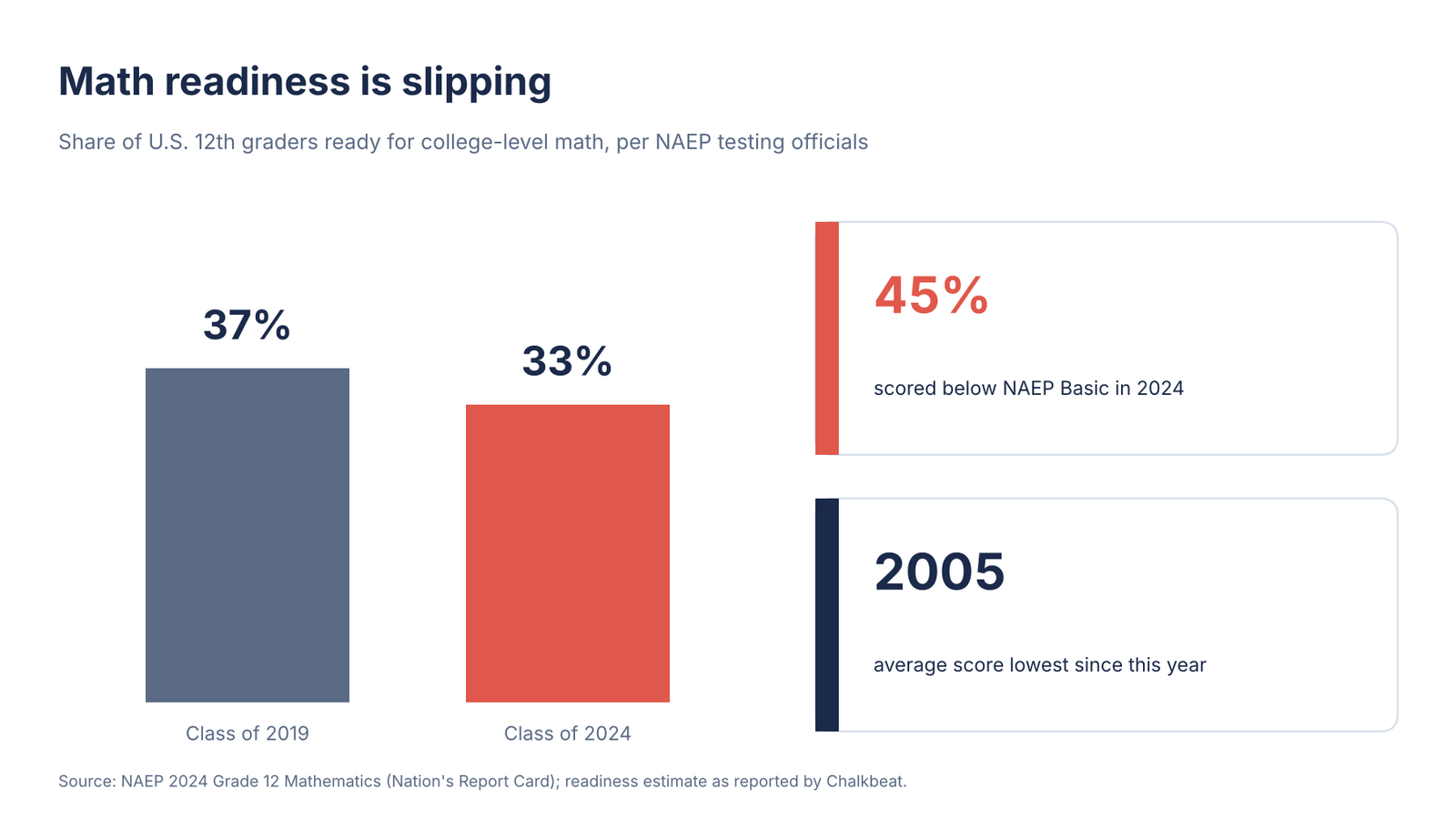
On the 2024 National Assessment of Educational Progress (NAEP), the average 12th grade math score was 3 points lower than in 2019, and the lowest since 2005. Testing officials estimated that 33% of the class of 2024 was ready for college-level math, down from 37% in 2019. And 45% of students scored below the NAEP Basic level.
Anxiety is part of the picture too. A study of mainly mature adult learners in STEM modules at the Open University found that 44% of the students who responded were visibly anxious about math. That was a conference presentation (Pawley and Organ, 2022), not a peer reviewed trial, so read it as a signal, not a universal rate.
The takeaway: a rough start in college math says very little about your ability. It often says something about gaps from earlier courses, and gaps can be repaired.
Why Math Feels So Hard
Math is cumulative. Each topic leans on the one before, so one shaky idea can make the next three confusing. Three things usually go wrong:
- A gap: you missed or never mastered an earlier skill.
- A method problem: you study in a way that feels productive but doesn’t stick.
- Anxiety: stress blocks working memory when a test starts.
Most students have a mix. The table below helps you spot which one is loudest.
| If this sounds like you… | Your main issue | Start with |
| “I follow the lecture but can’t do the homework” | Method problem | Practice testing and an error log |
| “I get lost two steps in” | Prerequisite gap | Day 1 and 2 of the plan |
| “I know it at home and blank in the exam” | Anxiety | Timed practice, then tutor support |
| “Everything is confusing” | Gap plus pace | Tutor trial, then the full plan |
Step 1: Find the Exact Gap
“I’m bad at math” is not a diagnosis. “I lose points on factoring” is.
Go through your last two graded assignments. List every question you missed, and next to each one write the skill it needed. Group them. Two or three skills usually explain most of the lost marks.
Those two or three skills are your targets for the week.
Step 2: Study the Way the Research Backs
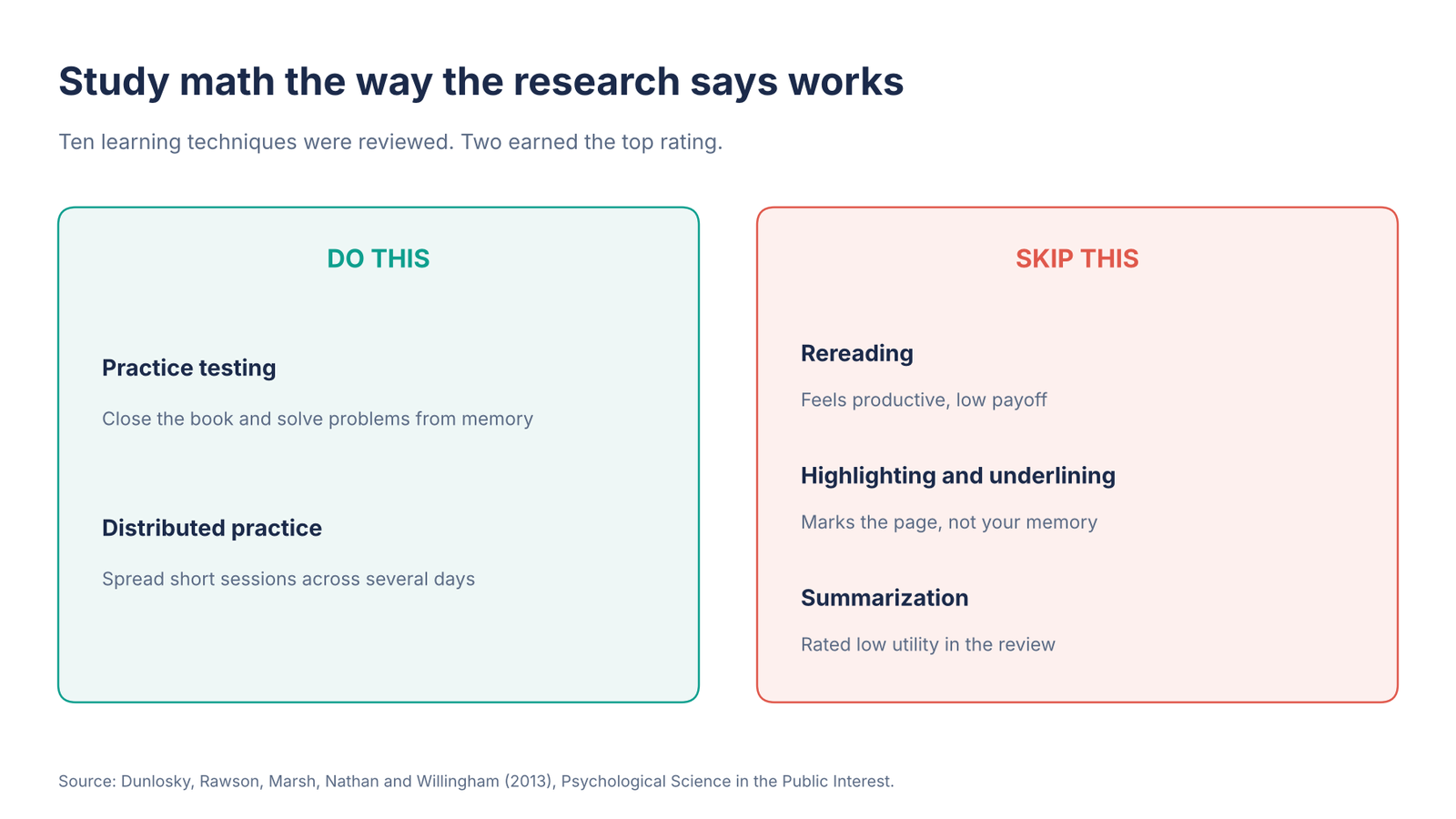
Here’s where most students waste hours. A major review of ten learning techniques by Dunlosky and colleagues (2013, Psychological Science in the Public Interest) rated just two as high utility: practice testing and distributed practice.
In math terms:
- Practice testing: close the notes and solve problems from memory. Check afterward.
- Distributed practice: spread short sessions over several days instead of one long block.
And the stuff to cut: rereading your notes, highlighting, and rewriting summaries. They feel good because the material looks familiar. Familiar is not the same as learned.
Step 3: Keep an Error Log
An error log is the cheapest upgrade you can make. It’s a simple table with four columns.
| Problem | What I did | What I should have done | Skill to review |
| Factor x² + 5x + 6 | Divided by x | Find two numbers that add to 5 and multiply to 6 | Factoring |
| Solve 3(x – 2) = 12 | Forgot to distribute | Expand first, then solve | Distributive property |
Every miss goes in the log. Every few days, redo the problems without looking. You’ll spot patterns fast, and patterns tell you exactly what to study.
The 7 Day Math Recovery Plan
Here’s the plan in one picture, then in words.
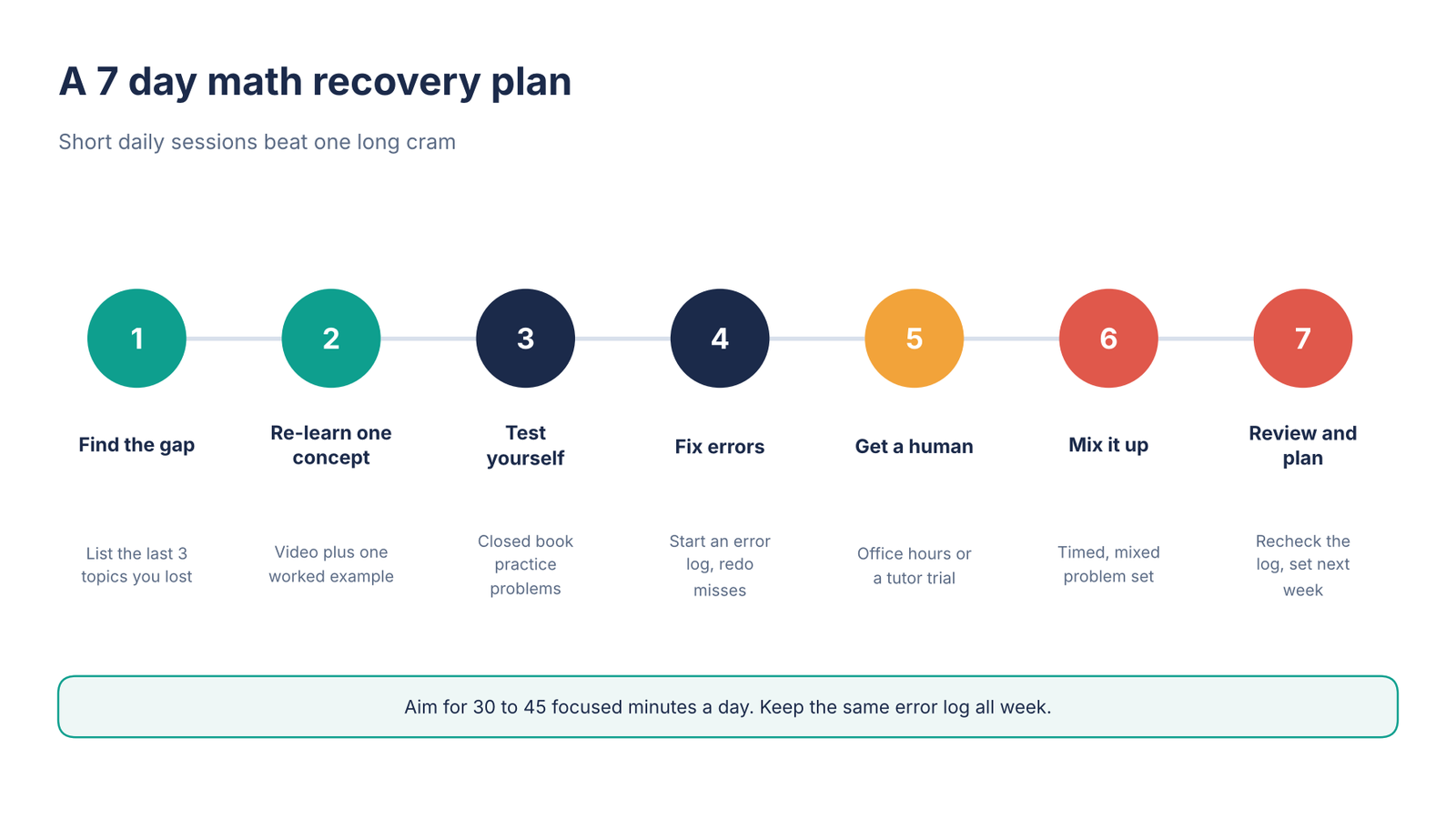
- Day 1, find the gap. List the last three topics you lost marks on.
- Day 2, re-learn one concept. Watch one explanation and work through one example step by step.
- Day 3, test yourself. Do practice problems with the book closed.
- Day 4, fix errors. Start the error log and redo every miss.
- Day 5, get a human. Go to office hours or book a tutor trial.
- Day 6, mix it up. Do a timed set that mixes topics, like an exam would.
- Day 7, review and plan. Recheck the log and set next week’s targets.
Example week: A student with a college algebra quiz on Friday lists their misses on Monday, finds factoring and distribution are the culprits, studies factoring on Tuesday, tests themselves on Wednesday, logs errors on Thursday, and sits the quiz Friday with a log of exactly what to avoid. (This is an illustration, not a testimonial.)
Handling Math Anxiety
Anxiety is real, and it’s not a character flaw. A few practical moves help most students:
- Do your practice under timed, exam-like conditions, so the real test feels familiar.
- Slow your breathing for a minute before you start a paper.
- Start with the question you know best, to build momentum.
- Treat a wrong answer as data. It tells you what to log.
If anxiety is intense or affecting your wellbeing beyond math, talk to your campus counseling or student support service. A tutor can help with the subject, but they’re not a substitute for that support.
When a Tutor Is Worth It
Try self-study first, but don’t wait until you’re failing. Book help when:
- You’ve done two weeks of practice and the same topic still breaks you.
- A prerequisite gap is blocking new material.
- A major exam or a final grade is close.
- You want someone to check your reasoning, not just your answers.
The evidence for tutoring is strong. A meta-analysis of tutoring experiments by Nickow, Oreopoulos and Quan found a pooled effect of 0.37 standard deviations, with effects stronger for teacher and paraprofessional tutors. That research covers preK-12, so it doesn’t prove the same size effect in college, but it matches what we see when students bring a specific, fixable problem to a session.
At PrestoExperts, tutors walk through your problems step by step so you learn the method. Start with our free math homework help, or browse the full tutoring directory. Taking statistics? See our SPSS statistics tutor page, and for numbers-heavy business courses, our accounting help.
Plan Your Grade Like a Project
Struggling students often don’t know what they need on the final to pass. Find out. Our Final Grade Calculator tells you the score you need, and the GPA Calculator shows what that does to your term. A clear target turns panic into a plan.
For study habits that help across every course, read how to study more in less time and the 1-2-3 method of studying. If you’re taking math online, our best online class help services page explains your options, and the online learning trends guide covers what’s changing.
Conclusion: Struggling Is a Starting Point
Struggling in math doesn’t mean you can’t do it. It means there’s a specific gap and a method that isn’t working yet. Find the gap, test yourself, space your practice, log your errors, and bring in a tutor before the deadline squeezes you.
Ready to turn math around? Book your free 20 minute trial session with a verified math tutor, or message us on WhatsApp and we’ll match you with the right expert.