A good research title tells a reader what you studied, who you studied and how, in one line. It sounds simple. Yet the title is often the part students rush, usually at midnight, just before submission.
This post gives you 7 simple rules for writing a good research title. Each rule comes with a weak and a strong example and a quick test you can run on your own title. At the end, you will find a table of title types and a fast way to get more ideas.
| The short version: Say what you studied, not that you studied it. Name the main variables, the group and the setting. Put the key words first. Match the wording to your method. Cut acronyms and filler. Then check your field’s habits and your supervisor’s rules. |
Why your research title matters more than you think
Your title does three jobs at once. It tells your marker what to expect. It tells a database or search engine what your paper is about. And it tells a busy reader whether to keep reading.
Journals take titles seriously. The Nature formatting guide says its titles should not exceed two lines in print, about 75 characters with spaces. It also says titles should not normally include numbers, acronyms, abbreviations or punctuation. Your module may be less strict, but the logic is the same: clear and short wins.
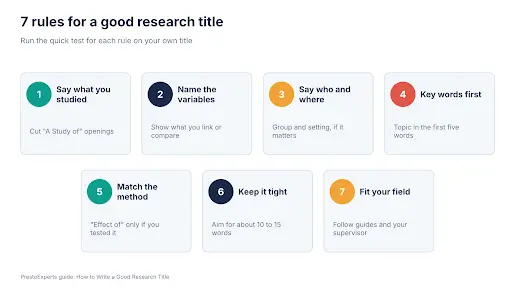
Figure 1: The 7 rules at a glance.
Rule 1: Say what you studied, not that you studied it
Weak titles start by describing the act of research: “A Study of,” “An Investigation into,” “Research on.” Every paper is a study, so these words tell the reader nothing.
| Weak | Strong |
|---|---|
| A Study of Customer Loyalty in Coffee Shops | Loyalty Apps and Repeat Visits in Independent Coffee Shops |
| An Investigation into Bridge Corrosion | Chloride Exposure and Corrosion Rates in Coastal Concrete Bridges |
Quick test: Delete the first three words of your title. If nothing important is lost, they were filler.
Rule 2: Name the main variables or concepts
A research title should show what you are linking, comparing or exploring. If you test whether one thing affects another, name both.
“Exercise and Students” is a topic. “Weekly Exercise and Exam Anxiety in First Year Students” is a research title. The reader can see the two variables and the group straight away.
Quick test: Underline the nouns in your title. You should find your main concept or concepts and your group. If you only find one vague noun, add the missing piece.
Rule 3: Say who and where
Results from one group or place do not always transfer to another. Your title should be honest about your scope.
| Weak | Strong |
|---|---|
| Remote Learning and Motivation | Remote Learning and Motivation Among Adult Learners in Online MBA Programs |
| Inflation and Household Spending | Food Inflation and Household Spending in Low Income Families in Karachi |
You do not always need both the group and the place. Add whichever one changes the meaning. A lab study on a material may not need a place at all.
Quick test: Ask “Who?” and “Where?” If the honest answer would surprise a reader, put it in the title.
Rule 4: Put the key words first
Readers scan from left to right and often stop after a few words. Search tools also show titles cut short on small screens. So lead with the words that carry your topic.
Compare these two:
- “The Role That Social Support Plays in Reducing Burnout Among Junior Doctors”
- “Social Support and Burnout Among Junior Doctors”
The second title loses nothing and puts both key terms in the first four words.
Quick test: Read only the first five words of your title. Can someone guess the topic? If not, move the key terms forward.
Rule 5: Match the wording to your method
Your verbs and phrases make promises about your research design. Keep them honest.
- “Effect of” or “Impact of” suggests you tested cause and effect, usually with an experiment or a strong design.
- “Relationship between” or “and” suits surveys and correlation studies.
- “Exploring,” “Experiences of” or “Perceptions of” suits interviews and other qualitative work.
- “A Comparison of” suits studies that compare two or more groups or methods.
If you ran a survey of 120 people, “The Impact of Flexible Hours on Productivity” overclaims. “Flexible Hours and Perceived Productivity Among Office Staff” is accurate, and markers notice the difference.
Quick test: Ask your supervisor or a classmate, “What method does this title suggest?” If their answer does not match your method, change the wording.
Rule 6: Keep it tight
Long titles are hard to read and easy to skim past. Short titles can be too vague. Aim for the shortest title that still covers rules 2 and 3.
Practical ways to tighten a title:
- Cut filler openings (see rule 1).
- Spell out acronyms or drop them. Write “Small and Medium Enterprises,” not “SMEs,” unless the acronym is better known than the full term.
- Remove words that repeat an idea, such as “future prospects” or “current trends today.”
- Replace phrases with single words: “in the context of” often becomes “in.”
As a working guide, many good titles land between 10 and 15 words. Check your own module or journal guide, because some set a firm limit.
Quick test: Count the words. If you are above 15, try cutting three without losing meaning.
Rule 7: Fit your field and your supervisor
Different subjects use different title styles. A history paper might use a quotation and a colon. A medical paper might state its finding as a full sentence. A business dissertation usually uses a plain descriptive title.
Here are the four main types of research titles and when to use each:
| Title type | Example | Best for |
|---|---|---|
| Descriptive | Mobile Banking Adoption Among Rural Women in Kenya | Most coursework and dissertations |
| Declarative (states the finding) | Early Physiotherapy Shortens Hospital Stay After Knee Surgery | Journal papers with a clear result |
| Question | Do Loyalty Apps Increase Repeat Visits? | Exploratory work and short articles |
| Compound (colon) | Paper Walls: Housing Quality in Informal Settlements of Lagos | Humanities, social sciences and creative angles |
If your department has a template or a word limit, it beats every rule here. Ask early, ideally when you submit your proposal.
Quick test: Find three recent papers in your field. Does your title look like theirs in length and style?
See the rules in action
Here is one weak title rebuilt step by step. Each step uses one rule.
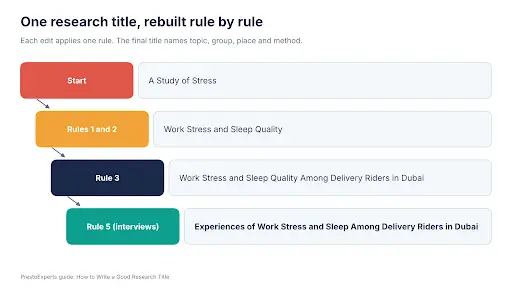
Figure 2: From a vague topic to a clear research title in four edits.
- Start: “A Study of Stress”
- Rule 1 and 2: “Work Stress and Sleep Quality”
- Rule 3: “Work Stress and Sleep Quality Among Delivery Riders in Dubai”
- Rule 5: If you ran interviews, change it to “Experiences of Work Stress and Sleep Among Delivery Riders in Dubai”
The final version tells the reader the topic, the group, the place and the method. It is 12 words long.
Common mistakes to avoid
Even after following the rules, a few traps catch students again and again:
- Promising too much. “Solving Unemployment in Pakistan” sets a goal no single paper can reach.
- Being too clever. A pun may get a smile, but it hides your topic from search tools.
- Writing the title first and never changing it. Your working title should change as your project changes.
- Copying a title format without checking the method. A borrowed “Impact of” title can overclaim your design.
Write a working title first, then the final one last
Start your project with a working title. It keeps you focused while you plan, read and collect data. But treat it as a draft.
Projects change. Your sample may shrink, your method may shift from a survey to interviews, or your findings may point somewhere new. When you finish your results and discussion, come back to the title and run the 7 rules again. The best final titles are written last, when you know exactly what your paper delivers.
Use a generator to break the blank page
Sometimes you know your topic but cannot find the words. A title generator can give you several options in seconds. You then apply the 7 rules to choose and edit the best one.
Try the Research project title generator with two or three specific keywords, such as your main concept and your group. Run it a few times, shortlist two or three options, and test each one against the quick tests above.
If you want ideas by subject before you start, Get Research Paper Title Ideas in One Click lists 30 examples and six title formulas you can adapt.
Get your title checked by an expert
A tutor can spot an overclaiming verb or a scope problem in seconds, before your supervisor does. Presto Experts connects you with verified tutors in business, nursing, education, technology and more. Your first 20 minutes are free, so you can bring your title and research question and get direct feedback.
Final check before you submit
Run your title through this short list:
- It names your main concept or variables.
- It says who or where, if that changes the meaning.
- The key words appear in the first half.
- The wording matches your method.
- There are no unexplained acronyms or filler openings.
- It fits your module or journal guidelines.
A clear title starts a clear paper
A good research title is not a creative writing task. It iResearch Titles a short, honest summary of your study. Follow the 7 rules, run the quick tests and adjust the style to your field.
Want a second opinion? Book a free 20 minute session with a tutor and bring your title, your research question and your method.