Finding the right research paper title can eat an afternoon. A good research paper title generator cuts that to a few minutes, but only if you pick one that fits your stage of writing.
Some tools need only a topic. Others need a finished abstract. A few add controls for academic level, research approach and sector, and those controls change the quality of what you get.
We compared eight popular tools on what they ask for, what they let you control, what they cost and who they suit. We also pulled in research on what makes a title work, so you can judge any generator’s output yourself.
Quick answer: For coursework, theses and dissertations, start with a topic-based generator that lets you set level and method. For a finished paper with an abstract, use an abstract-based tool to polish the wording. The table below shows exactly which is which.
In this guide
- How we compared the tools
- The 8 tools at a glance
- PrestoExperts Research Paper Title Generator
- Paperguide AI Research Title Generator
- Writefull Title Generator
- Originality.ai Research Title Generator
- Editpad Research Title Generator
- QuillBot AI Title Generator
- Grammarly AI Title Generator
- Paperpal and HIX
- What the research says about good titles
- 10 research title formulas with examples
- How to pick the right tool
- FAQ
How we compared the tools
We reviewed each tool’s public page on October 13, 2026. We compared seven things: what you must type in, the controls you get, how many titles you receive per run, whether you need an account, the price, the intended user and the main limits.
One disclosure matters here. PrestoExperts owns the first tool on this list. We placed it where we think it fits, and we say plainly where other tools do something better.
Where a detail came from a third-party review instead of the tool’s own page, we say so. Prices change often, so confirm the current price before you pay.
The 8 tools at a glance
| Tool | What you enter | Titles per run | Level, method or sector controls | Account needed | Cost |
| PrestoExperts | Topic, subject, level, optional keywords | 8 | Level (5 options), approach (8), sector (13), 6 title styles | No | Free, no stated limit |
| Paperguide | Abstract, topic or findings | 5 to 10 | Study type, domain, keywords, title length | Free to start | Paid plan from $12 per seat per month, billed annually |
| Writefull | A finished abstract | Not stated | None | No | Free generator |
| Originality.ai | Topic | You choose the number | Tone and field | No | Free with a daily cap |
| Editpad | Topic | You choose the number | Subject type and tone | No | Free, paid suite from $5.99 per week |
| QuillBot | Short description | Several | Tone | No | Free, Premium from $9.95 per month |
| Grammarly | Short description | Several | General prompt only | Not stated | Free tool |
| Paperpal and HIX | Varies | Varies | Varies | Yes | Free tiers, paid plans from $19.99 (HIX) and $25 (Paperpal Prime) per month |
Sources: each tool’s public page, plus Paperguide’s 2026 roundup for Editpad, Originality.ai, QuillBot and HIX pricing, and Capterra for Paperpal. Details checked October 13, 2026.
1. PrestoExperts Research Paper Title Generator
The PrestoExperts research paper title generator is built around the way students actually write. You enter a topic, pick your academic subject and level, then choose from six title styles.
It returns eight titles per run. You can click any card to copy it, or hit Regenerate for a fresh batch.
What it controls:
- Academic level: undergraduate, master’s, PhD, CIPD assignment and foundation or diploma.
- Research approach: quantitative, qualitative, mixed methods, literature review, comparative study, case study and systematic review.
- Industry or sector: 13 options, from healthcare and finance to SMEs, retail and energy.
- Subject list: business, finance, CIPD Levels 3, 5 and 7, nursing, computer science, psychology, law and more.
- Title styles: question, colon and subtitle, descriptive, impact, comparative and critical analysis.
Best for: coursework, dissertation and thesis titles where level and method matter.
Watch out for: it works from a topic, not an abstract. If your paper is finished, an abstract-based tool such as Writefull may phrase the final title more precisely.
Price: free, with no sign-up and no stated limit on generations.
2. Paperguide AI Research Title Generator
Paperguide’s generator accepts an abstract, a topic or key findings. That flexibility is its biggest strength. You can use it early with a topic or late with an abstract.
Its form also asks for study type, domain, must-have keywords, extra instructions, preferred title length and the number of titles. The page says each run produces 5 to 10 titles.
Best for: researchers who want one tool across drafting and submission, and who may also use a reference manager and paper writer.
Watch out for: the title tool is a doorway to a larger paid platform. Paperguide’s own review lists its Plus plan at $12 per seat per month, billed annually. That roundup also ranks Paperguide first, so read it with that in mind.
Price: free to start. The page says generation is unlimited during the first month with no card required.
3. Writefull Title Generator
Writefull takes a different route. You paste a finished abstract, and it suggests titles that reflect the paper’s content. According to Paperguide’s review, it was trained on large sets of title and abstract pairs.
That makes it strong at the end of the writing process. It is a poor fit for brainstorming because it needs text to work from.
Best for: polishing the final title of a paper with a completed abstract.
Watch out for: no tone, level or sector controls. We could not load Writefull’s own page when we checked, so these details come from the same third-party review. Confirm them on the site.
Price: the title generator is free. Group licenses for Writefull’s wider tools start at £228 per year for two users, per that review.
4. Originality.ai Research Title Generator
Originality.ai is known for AI detection, but it also offers a free research title generator. You enter a topic, choose a tone (academic, technical, creative or informative), pick a field and choose how many titles you want.
It needs no sign-up. The page shows a daily usage counter, with an example of 10 generations a day.
Best for: quick ideas if you already use Originality.ai for other checks.
Watch out for: limited control over academic structure. There are no level or approach settings.
Price: free with a daily cap.
5. Editpad Research Title Generator
Editpad keeps things simple. You type a topic, pick a subject type and tone, and choose how many titles to generate. No registration is needed.
Paperguide’s review describes the output as broad and often lacking academic depth, so treat the results as starting points.
Best for: fast brainstorming for short assignments.
Watch out for: generic titles for advanced research.
Price: free. The wider writing suite starts at $5.99 per week.
6. QuillBot AI Title Generator
QuillBot’s title generator is a general tool for blog posts, videos, essays and academic papers. QuillBot’s page says it is free with no sign-up, and you can set a tone such as formal or persuasive.
Because it is not built for research, it does not ask about your method, level or field.
Best for: quick inspiration across many content types.
Watch out for: titles that read well but lack scholarly precision.
Price: free. QuillBot Premium starts at $9.95 per month for the wider suite, per Paperguide’s review.
7. Grammarly AI Title Generator
Grammarly’s free title generator covers articles, emails, presentations and papers. Its page includes a research paper example that asks for an academic style title on a given topic.
It works from a plain prompt, so the quality of your prompt decides the quality of the titles.
Best for: students already writing in Grammarly who want a fast starting point.
Watch out for: no academic level, method or sector settings.
Price: free tool, with paid Grammarly plans for other features.
8. Paperpal and HIX
Two more names come up often. Paperpal generates titles inside its writing assistant, including a Word add-in. Capterra lists a free version and a Prime plan from $25 per month.
HIX offers a research title generator with options for audience, tone and language. Paid plans start at $19.99 per month, with limited free credits.
Both suit people who want titles as one feature inside a larger writing tool. If you only need a title, a free standalone generator costs less.
What the research says about good research titles
A generator gives you options. Research helps you choose between them. Here is what the evidence shows, and where it stays unclear.
| Finding | Study | What it means for you |
| Journals that publish shorter titles earn more citations per paper | Letchford, Moat and Preis, Royal Society Open Science, 2015. Based on the 20,000 most cited papers each year from 2007 to 2013 (about 140,000 papers) | Trim filler words. The authors note this is a correlation, not proof of cause |
| Question titles were downloaded more but cited less | Jamali and Nikzad, Scientometrics, 2011. Based on 2,172 articles in six PLOS journals | A question title can attract clicks, but a descriptive title may suit formal citation better |
| Titles with colons tended to be longer and got fewer downloads and citations | Jamali and Nikzad, 2011 | Use a colon only when the subtitle adds real information |
| The link between length and citations is mixed | Elsevier’s Research Trends, 2011, summarizing Jamali and Nikzad and a conflicting study by Habibzadeh and Yadollahie | Do not chase a magic word count. Clarity beats brevity for its own sake |
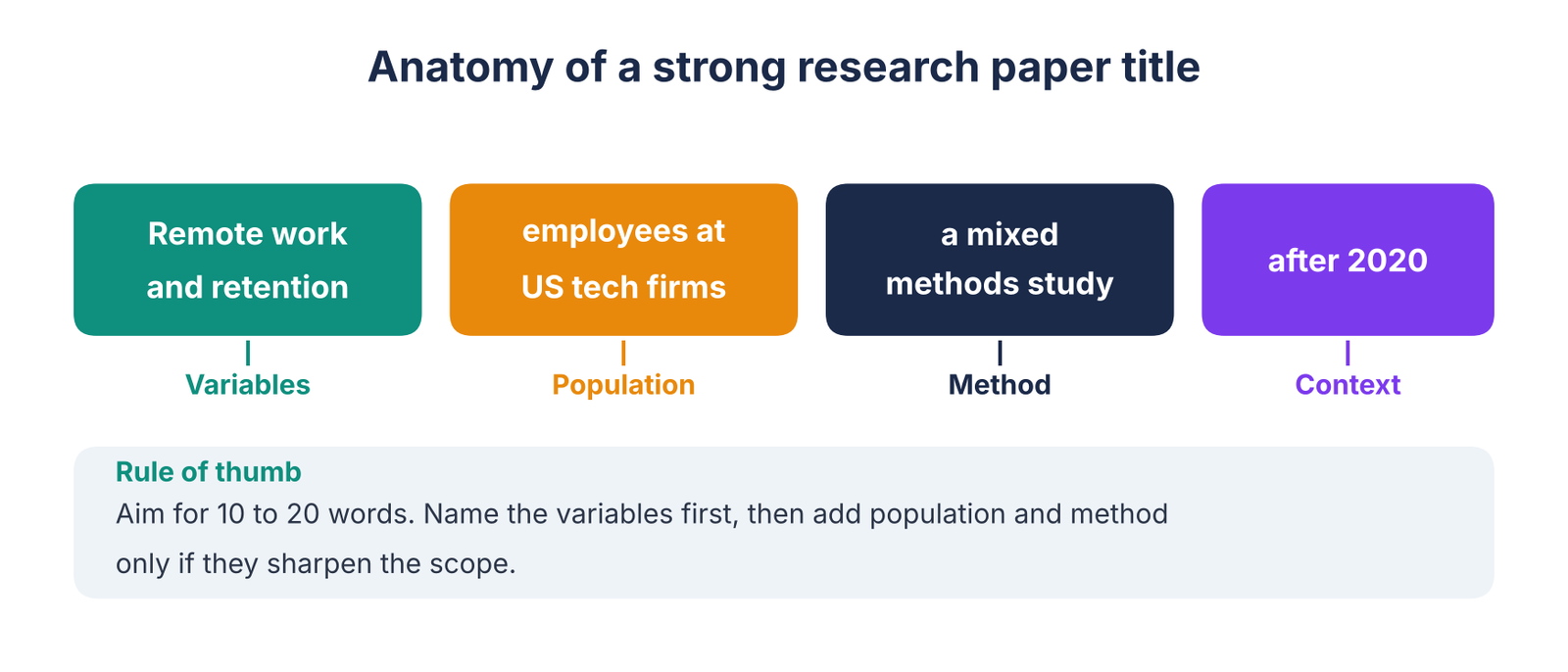
The PrestoExperts tool page suggests most strong academic titles run 10 to 20 words, which fits a clear-first approach.
Paperguide’s guide adds one practical rule. Finalize your title after you finish the paper, because your findings and scope often shift while you write.
10 research title formulas with examples
Every generator leans on a handful of patterns. Knowing them lets you edit the output instead of accepting it blindly. These examples are illustrative, not live tool output.
| Formula | Example | Use it when |
| Effect of X on Y | The Effect of Remote Work on Employee Retention in US Tech Firms | You test a cause and effect with data |
| Relationship between X and Y | The Relationship Between Employee Wellbeing and Retention in Small Businesses | You study association, not cause |
| Colon and subtitle | Digital Transformation in Community Banking: A Case Study Approach | A short hook needs a method or scope |
| Question | How Does Flexible Scheduling Shape Nurse Retention? | You want a conversational, inquiry-led title |
| Comparative | Renewable Energy Policy in the US and the EU: A Comparative Analysis | You compare two cases or regions |
| Exploring experiences | Exploring Experiences of First-Generation Students in Online Learning | You run interviews or focus groups |
| Critical analysis | A Critical Analysis of Performance Appraisal Practices in SMEs | You evaluate a framework or practice |
| Systematic review | Mindfulness Interventions for Student Stress: A Systematic Review | You synthesize published studies |
| Factors influencing | Factors Influencing Adoption of Mobile Banking Among Young Adults | You study drivers or barriers |
| Impact of X on Y | The Impact of Social Media Use on Adolescent Sleep Quality | You measure outcomes across a population |
How to pick the right research title generator
Use this short test:
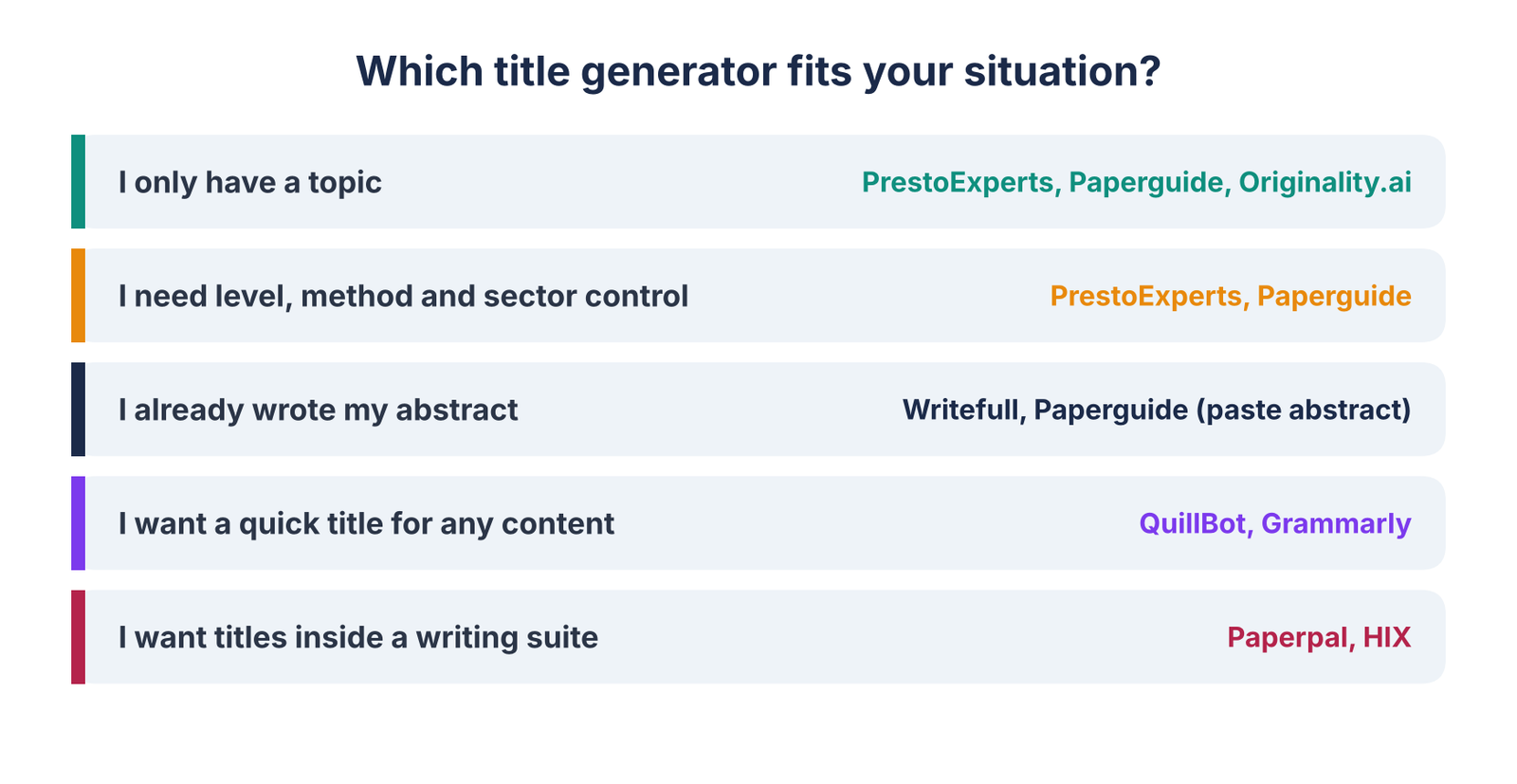
- Do you have an abstract? If yes, try Writefull or paste it into Paperguide.
- Do you only have a topic? Use a topic-based tool with level and approach controls, such as PrestoExperts or Paperguide.
- Is it a quick assignment? A simple free tool like Editpad, QuillBot or Grammarly is enough.
- Do you need a whole writing suite? Look at Paperpal or HIX, and compare the price against free alternatives.
A smart habit is to run two tools and merge the best parts. Combine a strong noun phrase from one with a clean subtitle from another, then edit for clarity.
Common mistakes when you use a title generator
- Accepting the first result. Treat output as a draft. Edit for scope, population and method.
- Choosing a title too broad to research. If your title could fit fifty different studies, narrow it.
- Mismatching title and method. A qualitative interview study should not carry a title that promises statistical effects.
- Using clever over clear. Examiners and journal editors reward precision.
- Skipping the final check. Compare your title with your finished abstract and conclusion before you submit.
FAQ
What is the best research paper title generator?
It depends on your stage. For topic-based titles with level and method controls, PrestoExperts and Paperguide both fit. For polishing a title from a finished abstract, Writefull is built for that job. For quick general ideas, QuillBot and Grammarly are fast.
Is there a free research paper title generator?
Yes. PrestoExperts, Originality.ai, Editpad, QuillBot, Grammarly and Writefull all offer free title generation. Some cap daily use, and some bundle paid plans for other features.
Can I use AI-generated titles for my thesis or dissertation?
You can use them as starting points. Edit the wording to match your scope, method and supervisor feedback. Check your university’s policy on AI tools, and disclose AI use if your institution requires it.
How long should a research paper title be?
Many strong academic titles run 10 to 20 words, though journals set their own limits. Research on citations shows mixed results on length, so aim for the shortest title that stays specific.
Should I write the title before or after the paper?
Write a working title early to keep your focus. Finalize it after you finish, so it matches your real findings.
Should I use a question or a colon in my title?
Both can work. One study of 2,172 PLOS articles found question titles were downloaded more but cited less, and colon titles tended to be longer with fewer downloads and citations. Use them when they add clarity, not by habit.
What is the difference between a research topic and a research title?
A topic is the broad area, such as employee retention. A title is the specific phrase describing your angle, population and method. A generator turns the first into the second.
Do title generators check for duplicate titles?
Some tools claim built-in duplication checks, so verify on the vendor’s page. Whatever tool you use, search your final title in Google Scholar and your library database before you commit.
Conclusion: pick the tool that matches your stage
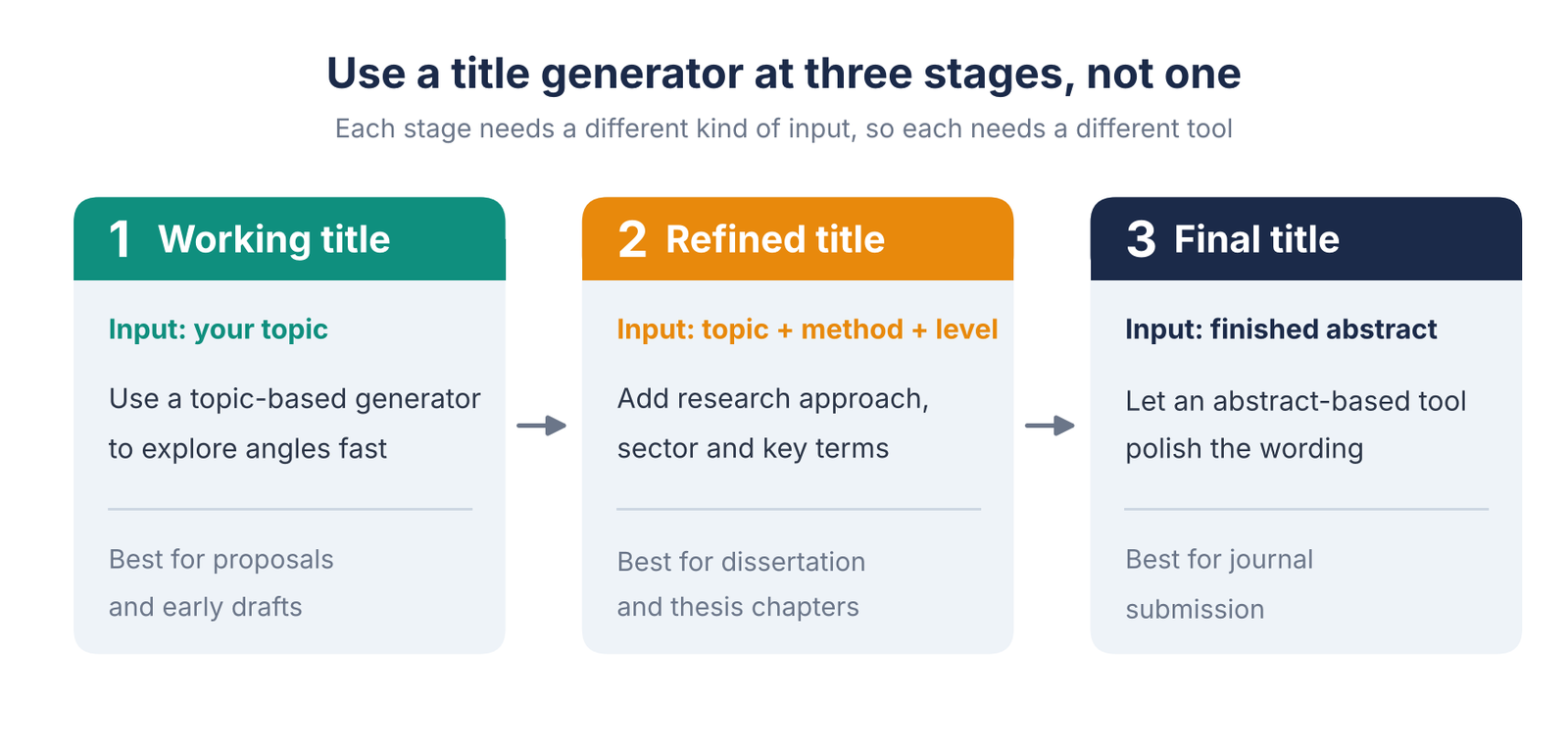
The best research paper title generator is the one that fits your input and your level. Use a topic-based tool early, add method and sector controls as your plan firms up, and use an abstract-based tool to polish at the end.
Then edit hard. Clear, specific, honest titles win with examiners, editors and readers.
Ready to try it? Open the free PrestoExperts research paper title generator and get eight options in seconds.
Need a human expert to sharpen your title, proposal or full paper? Our verified PhD and Master’s qualified tutors work one-on-one, 24/7, and your first 20-minute session is free. Message us on WhatsApp for a fast quote.
Next steps in your writing workflow:
- Build your argument with the thesis statement generator
- Plan your structure with the essay outline generator
- Format sources with the APA citation generator
- Run a free plagiarism check and an AI content check on your own draft
- Get publication support from our research publication experts
PrestoExperts papers and tutoring are intended for research, learning and reference purposes. Always follow your institution’s academic integrity policy.